Fall is the one season where the house tells you exactly what it needs and then gives you a deadline. Spring maintenance is cleanup. Summer is keeping the AC alive. Fall is prevention with a clock on it, and the clock is the first hard freeze. Everything on this list is a Saturday chore in October and a service call in February: a spigot that splits inside the wall, a furnace that quits on the coldest night of the year, a clogged gutter spilling water down the fascia and into the foundation all winter.
If you worked through the September checklist, you've already done the scouting: the furnace dress rehearsal, the gutter walk, the mouse-exclusion lap. This is the full-season list that picks up from there and runs until the ground freezes. It's organized by system so you can knock out one area at a time, and there's a timing table further down that sorts everything by deadline. Most of it is DIY. Some of it honestly isn't, and I'll say which.
Free printable: the whole list on one page
Want this checklist on the fridge instead of in a browser tab? Grab the free printable fall checklist: one page, every task below, boxes to check off. No signup needed. If you'd like a nudge when each season's list comes due, the newsletter at the bottom of this page sends exactly that and nothing else.
The three deadlines that run the whole season
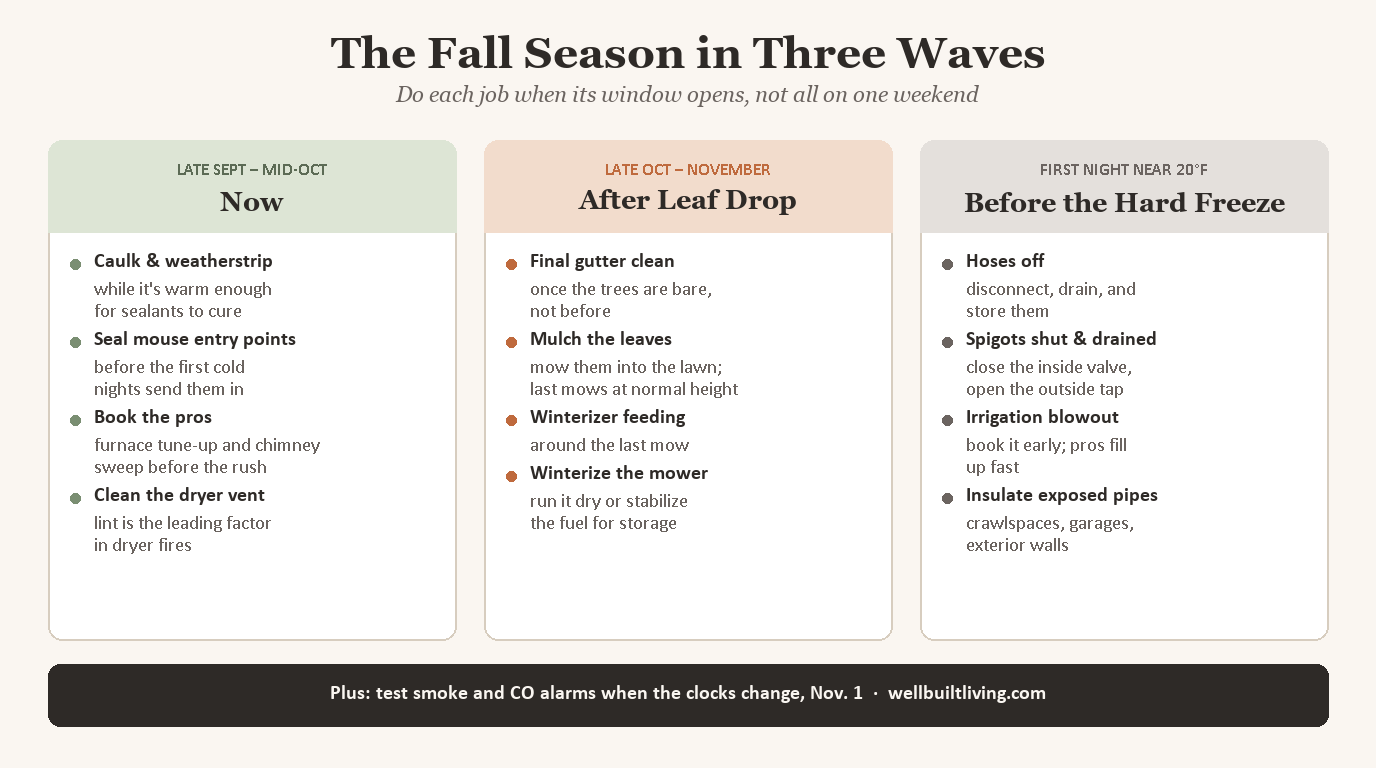
Fall maintenance isn't one weekend. It's three waves, and the trick is knowing which wave a job belongs to so you're not cleaning gutters twice or chasing a plumber after the freeze:
- Now (late September to mid-October): anything that needs mild weather, like caulk, paint touch-ups, and weatherstripping, plus booking the pros before the first cold snap backs everybody up.
- After leaf drop (late October into November, depending on your trees): the real gutter clean, the last mows, leaf management, and the lawn's winterizer feeding.
- Before the first hard freeze: spigots, hoses, irrigation, and anything else holding water outdoors. Watch the ten-day forecast; the first night in the low 20s is the one that matters.
Checklist 1
Exterior and the building envelope
The envelope is everything between your heated air and the outdoors. Fall is when gaps in it start costing money, and when the mice start looking for them. Do this wave first, while the afternoons are still mild enough for caulk and paint to cure properly (check the tube or can for its minimum application temperature).
- Re-caulk where trim meets siding and around window and door frames. Pull out anything cracked, shrunken, or peeling rather than caulking over it. The caulking guide covers bead technique.
- Replace flattened weatherstripping and door sweeps. The test is a dollar bill closed in the door: if it slides out with no drag, the seal isn't sealing. The weatherstripping guide walks through every type.
- Seal pipe and cable penetrations where they enter the house: steel wool or copper mesh first, then caulk or foam over it. Mice chew through sealant alone.
- Touch up bare wood on trim, sills, and fascia. Bare wood heading into a wet winter is rot's favorite starting point.
- Check window screens and storm windows. Swap to storms if you have them; pull screens that will just collect ice.
- Walk the foundation for new cracks, and make sure soil and mulch slope away from the house, not toward it.
If you want to know where your house actually leaks air instead of guessing, an evening with a stick of incense and the DIY energy audit will point straight at the worst gaps. Fall is the right time to do it: the indoor-outdoor temperature difference makes drafts easy to feel.
Checklist 2
Roof and gutters
September's job was inspection. This is the real clean (the full how-to, ladder setup included, is in the gutter cleaning guide), and the timing rule is simple: wait until most of the leaves are down. Cleaning gutters in early October just means cleaning them again in November. If you have a lot of big trees, plan on two passes: one mid-drop, one after the last oak gives up.
- Scoop the gutters and flush them with a hose, working toward the downspouts. If water backs up instead of draining, the downspout is clogged. Run the hose up from the bottom or feed a plumber's snake down from the top.
- Confirm every downspout empties at least a few feet from the foundation. A $10 extension or splash block is the cheapest basement waterproofing there is.
- Re-seat loose hangers. A gutter full of wet leaves or ice is heavy, and the sagging section you noticed in September is the one that lets go in January.
- Scan the roof from the ground with binoculars: missing or lifted shingles, cracked rubber boots around plumbing vents, and flashing pulling away at the chimney. Those three spots cause most roof leaks.
When to call a pro
A one-story house with a stable ladder and firm, level ground is a reasonable DIY gutter job. A two-story house, a steep roof, or a ladder standing on a slope is where ladder falls get serious. Hire it out: a gutter crew does it in an hour with the right equipment and insurance. Same for the roof itself. Look from the ground and let someone with fall protection do the walking.
Checklist 3
Heating, HVAC, and the chimney
The heating system runs harder for the next five months than any other equipment in the house, and it gets exactly one scheduled chance at a checkup before then. Here's the list:
- Book the professional tune-up if you haven't. This one is honestly a pro job. A technician checks the heat exchanger, burners, flame sensor, and venting, and on a gas furnace that inspection is as much about carbon monoxide as comfort. The CPSC urges an annual professional inspection of fuel-burning appliances for exactly that reason.
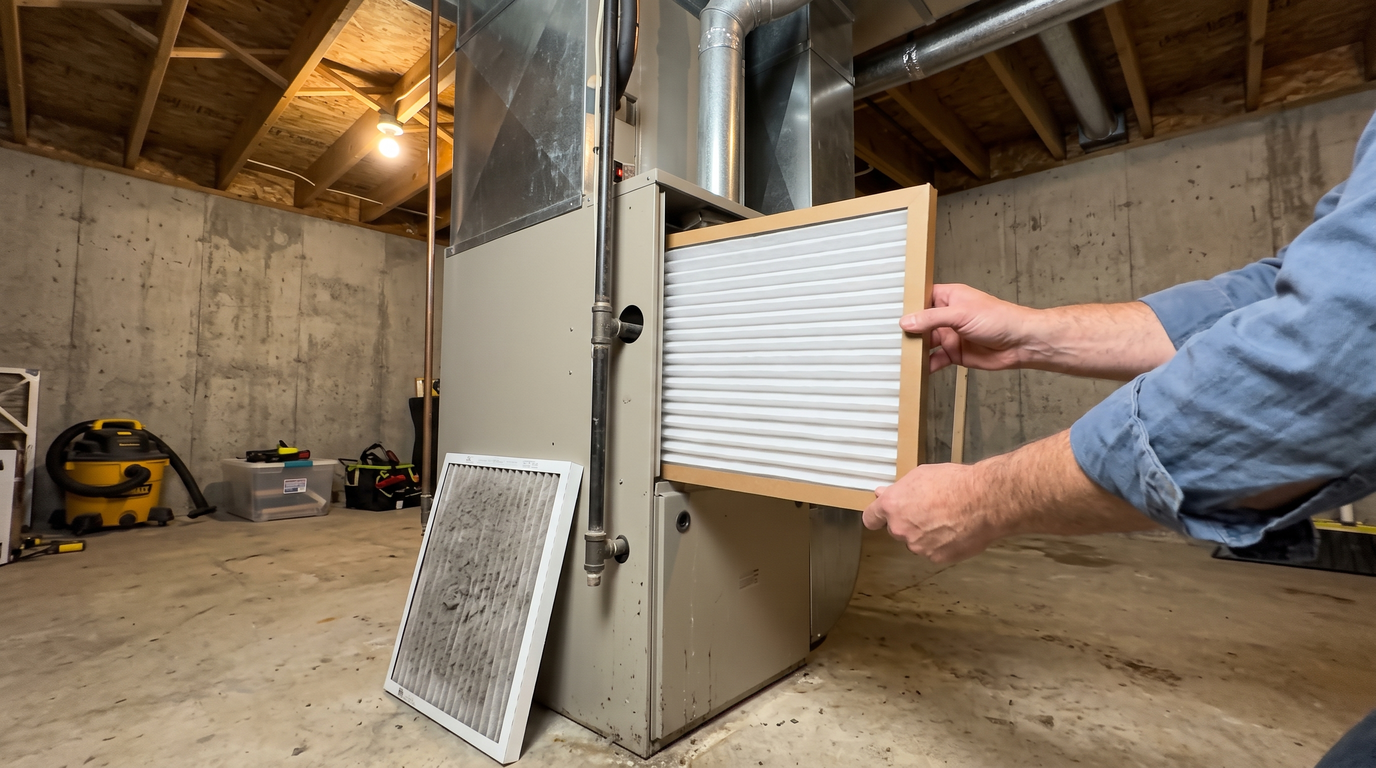
- Check the filter monthly through the heating season. ENERGY STAR's guidance is to check it every month and change it at least every three months. Homes with pets or dust usually need more often than that. The filter guide covers sizes, MERV ratings, and the arrow-direction thing everyone gets wrong once.
- Clear the vents and returns. Couches and bookshelves migrate over the summer. A blocked return starves the whole system.
- Clean around the furnace or boiler. Paint cans, cardboard, and laundry piles don't belong within a few feet of a burner.
- Bleed the radiators if you have hot-water heat, and check the boiler's pressure gauge against the range on its label.
- Reverse the ceiling fans to clockwise on low, which pushes warm air down off the ceiling without a draft.
- Set the heating schedule. If the thermostat is still running summer setpoints, program the heating schedule now, before the first chilly morning.
The chimney gets its own line. If you burn anything in a fireplace or wood stove, or have a gas fireplace or insert, the national standard for chimneys (NFPA 211) calls for an inspection at least once a year, and the Chimney Safety Institute of America recommends it for every fuel type, gas included. A year of fires leaves creosote. A year of not using it leaves bird and squirrel nests. Either one is a problem the first time you light a fire. Book a certified sweep before that first cool evening, because their calendars fill up at the same moment everyone else's furnace does.
Checklist 4
Plumbing and freeze prep
This is the section with a hard deadline. Water expands when it freezes, and a pipe split inside a wall doesn't announce itself until it thaws and floods. Research from the University of Illinois Building Research Council found that uninsulated pipes in unheated spaces start freezing when the outdoor temperature drops to about 20°F. Pipes exposed to drafts or wind can freeze well above that. So the goal is to have everything below done before the forecast shows the first night in the low 20s.
- Disconnect every garden hose. A hose left attached traps water in the faucet, and that includes "frost-free" sillcocks, which only work if they can drain. Drain the hoses and store them out of the sun.
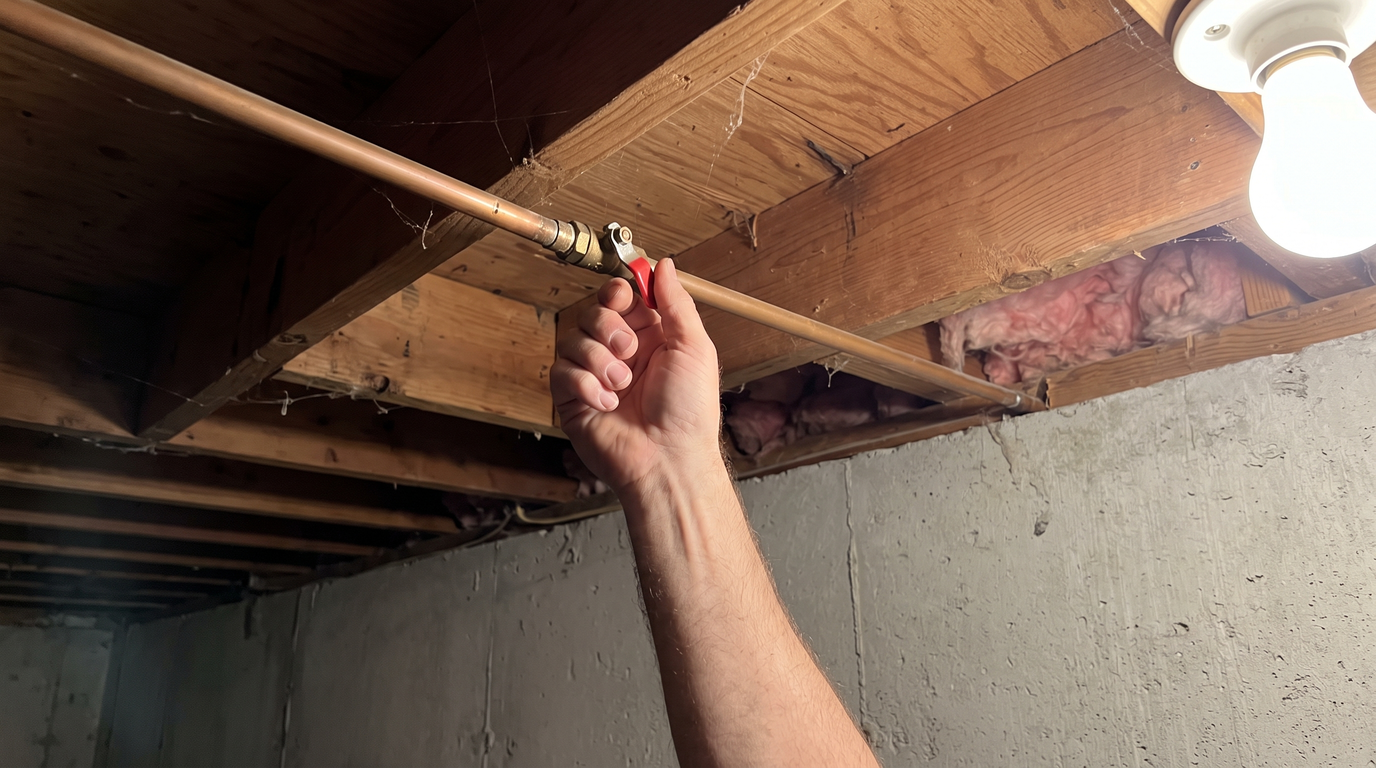
- Shut off and drain the outdoor faucets. Find the interior shutoff valve for each spigot (usually in the basement or crawlspace, near where the line exits the wall), close it, then open the outdoor faucet so the line drains. Leave the outside faucet open for the winter.
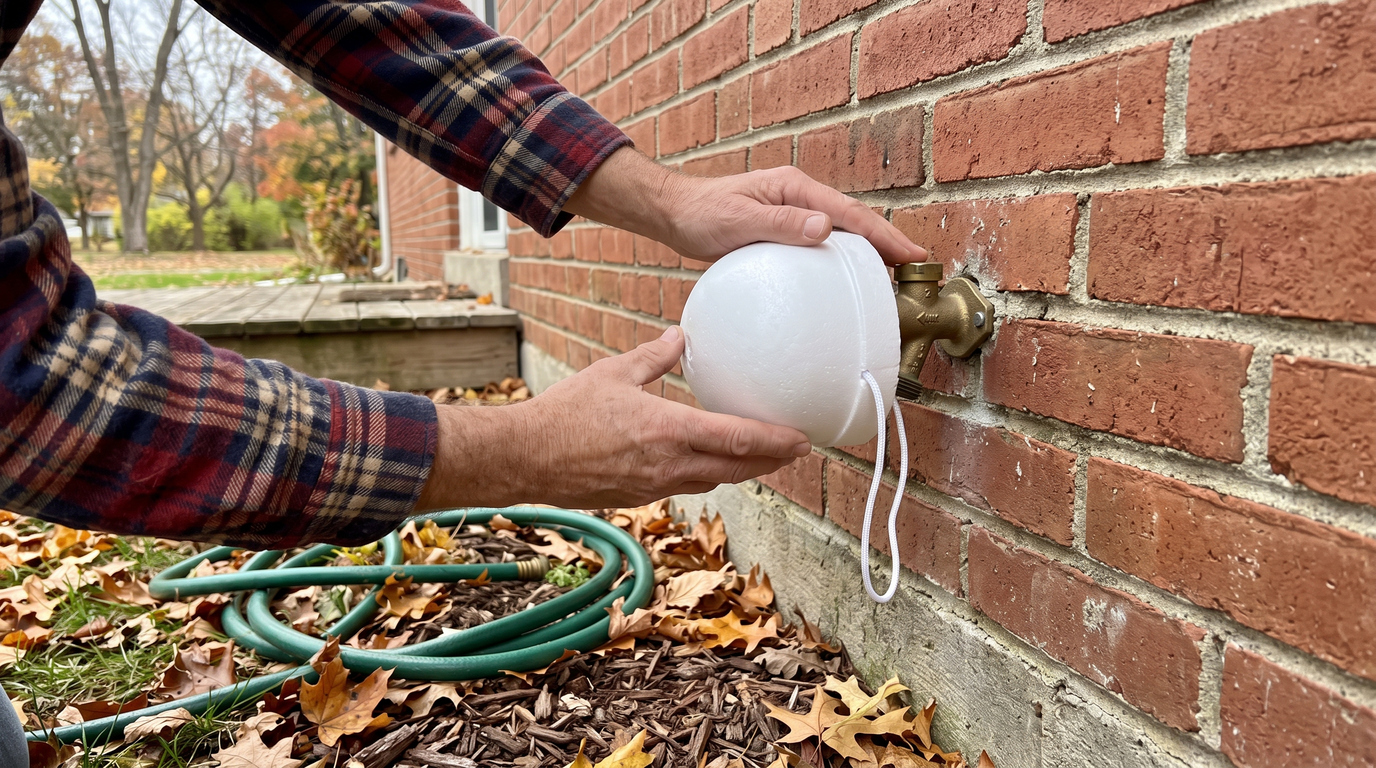
- Cover the spigots with an insulated faucet cover. It costs a few dollars and is cheap insurance, especially on a spigot with no interior shutoff.
- Insulate exposed pipes in crawlspaces, garages, and unheated basements with foam pipe sleeves. Pay the most attention to pipes along exterior walls.
- Get the irrigation system blown out before the first hard freeze. This one is a pro job for most people: it takes a high-volume compressor, and too much pressure can crack fittings. Book it early, because blowout companies backlog the same way furnace companies do.
- Test the sump pump with a bucket of water if you didn't in September. Fall rain and spring thaw are its busy seasons.
- Know where the main shutoff is, and make sure it turns. If a pipe does burst, every family member should be able to find that valve in the dark in under a minute.
Leaving for the holidays?
Don't turn the heat off in an empty house. Set the thermostat no lower than the mid-50s, open the cabinet doors under sinks on exterior walls so warm air reaches the pipes, and consider shutting the main water valve before you leave. A burst pipe you catch in an hour is a cleanup. One you find a week later is a remodel. If you're not sure whether a plumbing job is yours or a plumber's, the DIY vs. plumber guide draws the line honestly.
Checklist 5
Safety: detectors, dryer vent, and the fire basics
Heating season is when house fires and carbon monoxide both pick up, so the safety round belongs here. A handy anchor: daylight saving time ends Sunday, November 1 this year. Change the clocks, then run this list.
- Test every smoke alarm. NFPA recommends testing monthly and replacing smoke alarms every 10 years. Check the manufacture date on the back; the clock starts at manufacture, not when you installed it. Alarms with replaceable batteries get new batteries at least once a year. If you're replacing units anyway, a 10-year sealed-battery combo smoke and CO alarm ends the battery chore for a decade.
- Test the carbon monoxide alarms, and make sure you have one on each level of the house and outside each sleeping area. That's the CPSC's recommendation. CO alarms often wear out sooner than smoke alarms, so go by the replace-by date printed on the unit.
- Check the fire extinguisher gauge. The needle should be in the green. Keep one in the kitchen where you can reach it without walking past the stove.
- Space heaters get three feet of clearance from anything that burns, and they plug straight into the wall, not into an extension cord.
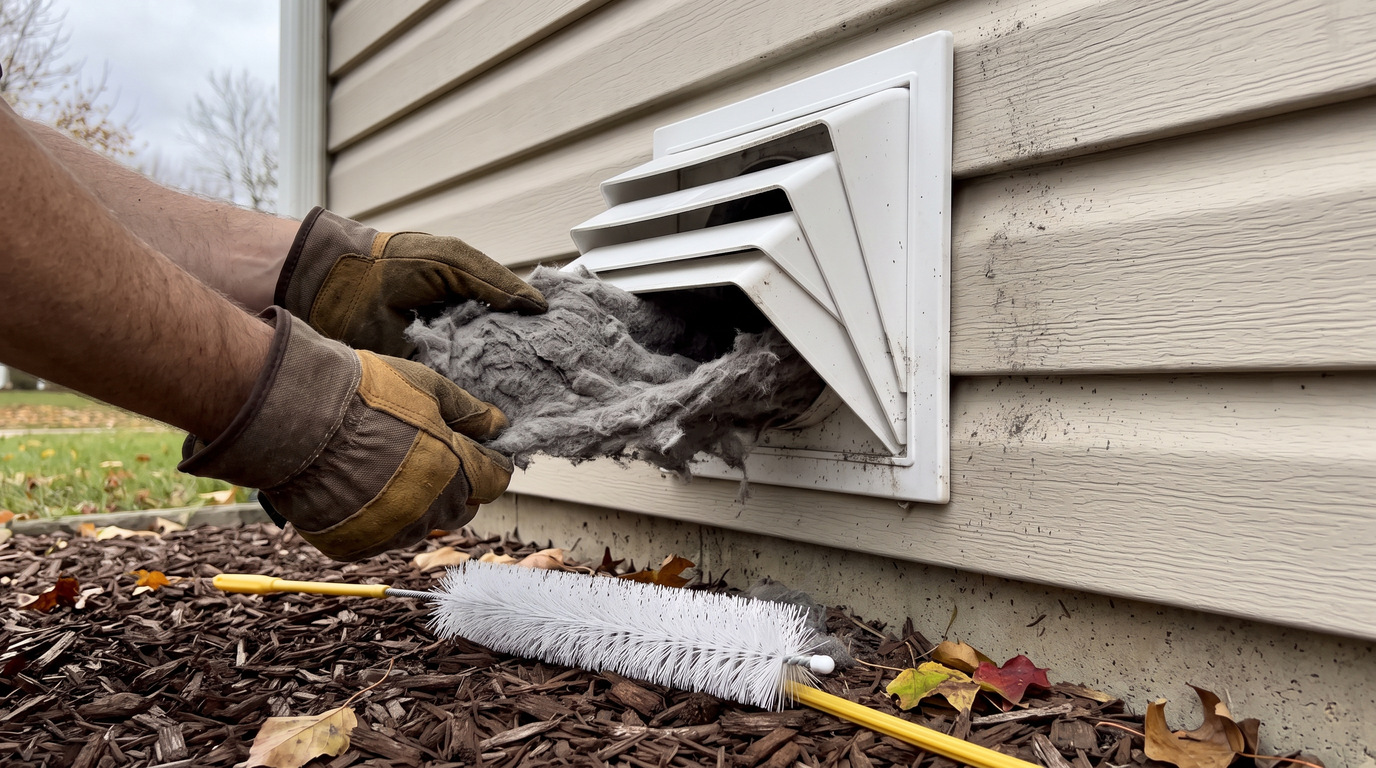
Then clean the dryer vent. All of it, not just the lint screen. According to NFPA, U.S. fire departments responded to an average of about 14,600 home fires a year involving clothes dryers or washing machines from 2014 to 2018. Among dryer fires, failure to clean was the leading contributing factor, in roughly a third of them. Lint builds up in the duct behind the dryer where you never see it. Pull the dryer out, disconnect the duct, and run a dryer vent brush kit through it from both ends. Then go outside and make sure the exterior flap opens freely when the dryer runs and closes when it stops. Warning signs you're overdue: loads taking two cycles to dry, or the laundry room getting noticeably hot.
While the dryer is pulled out, replace any white vinyl or thin foil accordion duct with rigid or semi-rigid metal duct. The flimsy stuff crushes, sags, and traps lint. If your vent runs a long way, has several turns, or exits through the roof, that's a reasonable job to hire a vent-cleaning service for.
Checklist 6
Yard, garden, and equipment
The lawn has its own detailed plan in the fall lawn care guide, including when to aerate, the overseeding deadline, and why you should mulch leaves instead of raking them. The short version for this list:
- Keep mowing at your normal height as long as the grass keeps growing. Don't scalp the last cut.
- Mulch leaves with the mower when you can still see grass through them, and rake only when they blanket the lawn.
- Put down the winterizer feeding around the last mow, if you're growing cool-season grass.
- Winterize the mower: run the last tank dry or add fuel stabilizer and run it a few minutes so treated fuel reaches the carburetor. Clean the deck while you're at it. Battery mowers just need the battery stored indoors, per the manual.
- Deep-clean and cover the grill, or keep grilling. Either way, the grill maintenance guide has the end-of-season routine.
- Clean and store the outdoor furniture and cushions dry. Cushions put away damp come out moldy in April.
- Cut back branches overhanging the roof or touching the siding, and look for dead limbs over the driveway or house. Anything big or near a power line is an arborist's job.
- Stage the winter kit: snow shovel, ice melt, and the snowblower's first start of the season, before the first storm.
The season at a glance: when it's due and who should do it
Here's the same list sorted by deadline, with an honest call on DIY versus pro. The "pro" answers aren't about skill. They're about equipment, height, or gas and combustion safety, where a mistake costs more than the service call.
Fall maintenance questions I get every year
When should I start fall maintenance? Late September for the weather-sensitive jobs and the bookings, then work down the list as the leaves and the forecast dictate. The only true emergency deadline is the first hard freeze, and the ten-day forecast will give you a week's warning if you're watching it.
I skipped the furnace tune-up last year and it was fine. Do I really need one? The furnace running isn't the same as the furnace running safely. A cracked heat exchanger or a blocked flue doesn't necessarily stop the heat; it just changes where the exhaust goes. The tune-up is the part of this list that protects the people in the house, which is why it stays on it. Working CO alarms are the backup, not the substitute.
I have frost-free spigots. Can I skip the shutoff? You can usually skip the interior shutoff, but not the hose. A frost-free sillcock keeps its valve deep inside the heated wall and relies on the outside section draining. A hose left attached holds water in that section, and that's how "frost-free" spigots split. Disconnect the hose either way.
What's the one thing to do if I only have an hour? Disconnect the hoses and shut the outdoor faucets, test the smoke and CO alarms, and make the two phone calls: furnace and irrigation. Those cover the costliest failures on the list. The rest can happen over the next few weekends.
Keep the list, keep the record
Print the one-page fall checklist and stick it somewhere you'll see it every weekend. Checking boxes is oddly motivating. If this is your first fall in the house, it's also worth writing down what you did and when: the filter size, the date of the tune-up, which valve feeds which spigot. The free worksheet pack from the First-Time Homeowner's Handbook has a Home Maintenance Log and a Home Measurement Reference built for exactly this, so next October you're following your own notes instead of hunting around the basement with a flashlight.
That's the season. It's a lot of items, but none of them is hard, and most take less time than finding the right ladder. The September checklist did the scouting, the lawn guide handles the yard, and this list gets the rest of the house to spring with no surprises. Winter has plenty of those on its own.