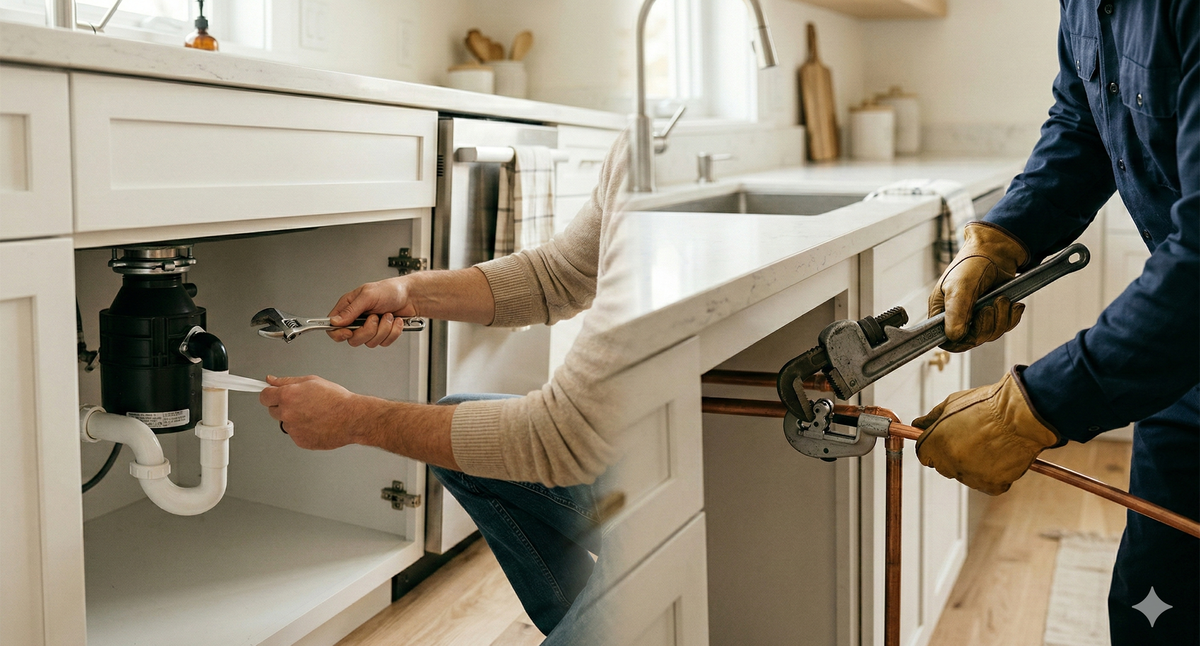
Two years ago, I decided I was going to replace the kitchen faucet myself. How hard could it be? I'd watched a YouTube video, I had an adjustable wrench, and I had what I now recognize as a dangerous amount of confidence. Four hours later, I was lying on my back in a puddle of water, the old faucet was still attached (with a stripped nut I couldn't budge), I'd broken the sprayer hose, and I'd used language that made my wife close the kitchen door. I called a plumber the next morning. He had the old faucet out and the new one installed in 45 minutes.
Here's the thing, though — I didn't need to call a plumber for that job. The problem wasn't that faucet replacement is too hard for a homeowner. The problem was that I didn't have the right tool (a basin wrench, which costs $15), didn't know the trick for seized nuts (penetrating oil, wait 20 minutes), and didn't watch enough of the video to learn either of those things. The plumber's bill was $225 for a job I could have done for $15 in tools.
On the other hand, when my water heater started leaking from the bottom last winter, I knew immediately that was a pro job. Not because I couldn't physically do it — I could have watched a tutorial and muddled through. But because water heater installation involves gas lines, requires permits in most jurisdictions, and a mistake could result in a gas leak, carbon monoxide poisoning, or a flooded basement. Some jobs just aren't worth the risk.
That's what this guide is about: helping you figure out which plumbing tasks fall on each side of that line. The goal isn't to make you a plumber — it's to help you handle the stuff that's genuinely simple and save your money for the jobs that genuinely need a pro.
The DIY-Friendly Jobs
These are plumbing tasks that most homeowners can handle with basic tools, a little patience, and a decent YouTube tutorial. They carry low risk of causing serious damage if something goes wrong, and the savings from doing them yourself are significant — typically $150-300 per job in avoided service calls.
Unclogging drains
This is Plumbing 101, and you should absolutely handle this yourself before calling anyone. A slow or clogged drain in a sink, tub, or shower is almost always caused by hair, soap buildup, or food debris that's accumulated in the trap or the first few feet of pipe.
Start with a plunger. If that doesn't work, try a hand-crank drain snake (about $25). For kitchen sinks, sometimes the clog is in the P-trap — that U-shaped pipe under the sink — which you can unscrew by hand, clean out, and reinstall in about 10 minutes. We wrote a full guide on how to unclog a drain if you want the step-by-step.
When to call a pro: if multiple drains are slow at the same time, the clog is likely in your main sewer line, not the individual drain. That needs a powered auger or camera inspection. More on this in the "hire a plumber" section below.
Fixing a running toilet
A toilet that runs constantly or "phantom flushes" (refills on its own every few minutes) is almost always caused by one of two cheap parts: the flapper or the fill valve. Both are under $15, available at any hardware store, and can be replaced in 15-30 minutes with no special tools.
The flapper is the rubber seal at the bottom of the tank. Over time, it warps or deteriorates and stops sealing properly. Turn off the water supply valve behind the toilet, flush to empty the tank, unhook the old flapper, hook on the new one, and turn the water back on. That's it.
If the flapper isn't the issue, it's probably the fill valve (the tall assembly on the left side of the tank). Universal fill valves are $8-12 and come with instructions. The whole replacement takes about 20 minutes.
Quick test: Put a few drops of food coloring in the toilet tank and wait 15 minutes without flushing. If the color shows up in the bowl, your flapper is leaking. A leaking flapper can waste 200+ gallons of water per day — that's real money on your water bill, plus the constant running noise.
Replacing a faucet
Despite my earlier story, faucet replacement is a very doable DIY job once you have the right tools and know what to expect. The key tool is a basin wrench — a long-handled wrench designed to reach the mounting nuts in the tight space behind the sink basin. Without one, you're fighting gravity and geometry. With one, the job is straightforward.
The typical process: turn off the water supply valves, disconnect the supply lines, remove the old faucet mounting nuts (this is where the basin wrench earns its keep), lift out the old faucet, set the new one in place, tighten the mounting nuts, reconnect the supply lines, and turn the water back on. Most faucets come with good instructions and all the hardware you need.
Budget about 1-2 hours for your first faucet. After you've done one, you'll knock out the next in 30-45 minutes.
Replacing a showerhead
This might be the easiest plumbing job that exists. Unscrew the old showerhead (counterclockwise, by hand or with pliers wrapped in a cloth to prevent scratching). Wrap the threads on the shower arm with 2-3 wraps of plumber's tape (Teflon tape). Screw on the new showerhead. Hand-tight plus a quarter turn with pliers is all you need. Done. Five minutes.
Fixing a leaky faucet
A dripping faucet is usually a worn O-ring, washer, or cartridge — parts that cost $5-15. The hardest part is identifying which type of faucet you have (ball, cartridge, disc, or compression) so you buy the right parts. Take a photo of your faucet, look up the brand and model, and search for the repair parts. Hardware stores carry repair kits for all the major brands.
The basic process: turn off the water supply, remove the faucet handle (usually a set screw under a decorative cap), pull out the cartridge or stem, replace the worn parts, and reassemble. A single dripping faucet can waste 3,000+ gallons per year, so this fix pays for itself quickly.
Replacing supply lines and shut-off valves
Those braided stainless steel hoses connecting your faucets and toilets to the wall can deteriorate over time. If you see corrosion, bulging, or any sign of moisture, replace them preemptively — a burst supply line is one of the most common causes of household water damage. Turn off the water, unscrew the old line, screw on the new one, and hand-tighten plus a quarter turn. Replacement lines are $5-15 each.
The Gray Zone: DIY-Possible but Proceed with Caution
These jobs are doable for a motivated homeowner with some research, but they carry more risk and require more planning. If you're uncomfortable with any step, there's no shame in calling a pro.
Replacing a garbage disposal
If your old disposal uses the same mounting bracket as the new one (and many do), this is a straightforward swap: disconnect the power, twist off the old unit, twist on the new one, reconnect the plumbing and power. Budget 1-2 hours. If the mounting bracket is different or you need to modify the drain plumbing, the complexity increases. Also, if the disposal is hardwired (rather than plugged in), you're now doing electrical work too — and that changes the calculation for some people.
Installing a new toilet
Toilet replacement is physically simple but involves a few details that matter: getting a good seal with the wax ring, ensuring the toilet is level, and not cracking the porcelain by over-tightening the bolts. The biggest challenge is usually the weight — toilets are heavy and awkward to maneuver. If you have a helper and follow instructions carefully (especially the part about hand-tightening the bolts), this is a manageable DIY that saves $200-400 in labor.
Replacing a water supply valve
If you need to replace a shut-off valve (the valve on the wall that controls water to a specific fixture), you're working with the house plumbing rather than just a fixture. Compression-style valves on copper pipe can be replaced without soldering. If the valve requires soldering (sweat fitting) or is on a galvanized steel pipe, the difficulty goes up considerably. Know what you're getting into before you start.
Thawing frozen pipes
If a pipe freezes but hasn't burst, you can often thaw it yourself with a hair dryer, heat lamp, or heating pad applied to the frozen section. Open the faucet first so water can flow as it melts. Never use a torch or open flame — that's how people start house fires. If you can't locate the freeze or if the pipe has already burst, call a plumber immediately and shut off the main water supply to limit damage.
Always Hire a Plumber
These jobs involve risk levels that make DIY a bad bet for most homeowners — either because of safety concerns, permit requirements, or the potential for expensive damage if something goes wrong.
Main sewer line problems
If multiple drains in your house are slow or backing up simultaneously, the problem is in your main sewer line — not in individual fixture drains. This requires a powered auger, often a camera inspection, and sometimes excavation. Tree roots growing into the line, bellied (sagging) pipe sections, and collapsed old pipes are common causes. A plumber with a sewer camera can diagnose the exact problem and location before any digging happens. Costs range from $200-500 for a basic clearing to several thousand for line repair or replacement.
Water heater installation
Water heater installation involves gas lines (for gas models), high-voltage electrical connections (for electric models), proper venting, pressure relief valves, and seismic strapping in some regions. Most jurisdictions require a permit and inspection. Beyond the technical requirements, water heaters are heavy, awkward, and filled with water that needs to be drained before removal. A failed installation can result in gas leaks, carbon monoxide exposure, flooding, or fire. This is a $800-2,500 professional job, and it's worth every penny for the safety and code compliance.
Never DIY gas line work. Gas leaks can cause explosions, fires, and carbon monoxide poisoning. Any work on gas lines — connecting a gas water heater, moving a gas line for a kitchen remodel, or even replacing a gas valve — should be done by a licensed plumber or gas fitter. This is not a cost-savings opportunity. It's a safety-critical task that requires proper tools, testing, and permits.
Sewer line replacement or repair
If your sewer line needs to be repaired or replaced, this involves excavation, specialized equipment, and knowledge of local codes. Modern trenchless methods (pipe lining and pipe bursting) are less invasive but require specialized equipment and training. Costs range from $1,000 for a spot repair to $5,000-15,000 for full line replacement. Always get multiple quotes and ask about trenchless options, which may save money and avoid tearing up your yard.
Repiping
If your home has old galvanized steel pipes that are corroded and restricting water flow, or polybutylene pipes (gray plastic pipes common in 1978-1995 homes that are prone to failure), whole-house repiping is a major job. It involves opening walls, running new copper or PEX piping throughout the house, and reconnecting every fixture. This is a multi-day professional job costing $4,000-15,000 depending on house size and accessibility, but it's sometimes necessary and dramatically improves water pressure and reliability.
Any work that requires a permit
If your local building code requires a permit for the work — and it does for most plumbing work beyond simple fixture replacement — hire a licensed plumber. Permits exist to ensure the work is done safely and to code. Unpermitted work can create liability issues, problems when selling your home, and insurance complications if something goes wrong. A licensed plumber handles the permit and inspection process as part of the job.
The Quick Reference Table
| Job | DIY? | DIY Cost | Pro Cost |
|---|---|---|---|
| Unclog a drain | Yes | $0-25 | $150-300 |
| Fix a running toilet | Yes | $8-15 | $150-250 |
| Replace a faucet | Yes | Faucet cost only | $200-400 |
| Replace a showerhead | Yes | Showerhead cost only | $75-150 |
| Fix a leaky faucet | Yes | $5-15 | $150-300 |
| Replace a toilet | Cautious yes | Toilet cost only | $300-600 |
| Replace garbage disposal | Cautious yes | Disposal cost only | $250-500 |
| Install water heater | No | — | $800-2,500 |
| Main sewer line work | No | — | $200-5,000+ |
| Gas line work | Never | — | $150-800 |
| Whole-house repiping | No | — | $4,000-15,000 |
How to Find a Good Plumber (When You Need One)
When you do need a professional, finding a reliable one is half the battle. Here's what I've learned from both good and bad experiences:
Get recommendations first. Ask neighbors, friends, or your real estate agent. The best plumbers stay busy through word of mouth and don't need to advertise aggressively. Nextdoor and local Facebook groups are also good sources for real reviews from people in your area.
Verify licensing and insurance. A licensed plumber has passed exams and meets your state's training requirements. Insurance protects you if something goes wrong during the work. You can usually verify a plumber's license through your state's licensing board website. Don't skip this step — unlicensed work can void your homeowner's insurance coverage.
Get at least two quotes for non-emergency work. Pricing varies significantly between plumbers, especially for larger jobs. A written quote should include the scope of work, materials, labor, and any permit costs. Be wary of quotes that are dramatically lower than others — that can indicate cut corners, unlicensed work, or a bait-and-switch where costs escalate once the job starts.
Ask about warranties. Reputable plumbers guarantee their work for at least a year. Some offer longer warranties on major installations. Get the warranty in writing.
Build a relationship before the emergency. The worst time to find a plumber is when water is pouring out of a pipe at 10 PM. Find a reliable plumber through a small job (like a faucet replacement you don't want to tackle yourself) and keep their number saved. When an emergency hits, having a plumber who knows your house and trusts you as a customer is invaluable — they'll prioritize your call.
The Bottom Line
Knowing where the DIY line falls isn't about being cheap or being brave — it's about being practical. Every dollar you save by fixing a running toilet yourself is a dollar available for the things that actually need a professional. And every time you call a pro for the jobs that genuinely require one, you're protecting your home, your safety, and often your wallet from the kind of damage that DIY mistakes in over-your-head territory can cause.
Start small. Fix a leaky faucet. Unclog a drain. Replace a showerhead. Build your confidence and your toolkit one job at a time. And when something feels like it's beyond your skill or comfort level, call a pro without guilt. That's not failure — that's smart homeownership.
Frequently Asked Questions
Can I fix a leaky faucet myself?
Yes — it's one of the most common and beginner-friendly plumbing DIYs. Most faucet leaks are caused by worn O-rings, washers, or cartridges that cost $5-20 in parts. Turn off the water supply, disassemble the handle, replace the worn part, and reassemble. Search for your specific faucet brand and model for a tutorial that matches your hardware.
When should I call a plumber instead of doing it myself?
Call a pro for main sewer line issues, water heater installation, any gas line work, jobs requiring permits, and any situation where you've been trying for a while and it's not working. Also call immediately for any active leak you can't stop — the water damage cost of "I'll figure it out eventually" adds up fast.
How much does a plumber typically cost?
Most charge $75-150 per hour with a minimum service call of $50-100. Simple fixture repairs run $150-300 total. Water heater replacement is $800-2,500. Sewer line work ranges from $200 for a basic clearing to several thousand for repair or replacement. Always get at least two written quotes for non-emergency work.
What plumbing tools should every homeowner own?
A cup plunger (for sinks) and a flange plunger (for toilets), an adjustable wrench, a basin wrench, plumber's tape (Teflon tape), and a hand-crank drain snake. This kit covers most common household plumbing tasks and costs under $60 total. If you want to see our full recommended toolkit, check out our essential tools guide.
Is it worth learning basic plumbing as a homeowner?
Absolutely. The basics — unclogging drains, fixing running toilets, replacing faucet parts, knowing how to shut off water in an emergency — save hundreds of dollars per year and prevent minor issues from turning into expensive emergencies while you wait for a plumber. Most of these skills take an afternoon to learn.