Everyone knows gutters need cleaning in the fall. Almost nobody knows when in the fall, so the job lands in one of two places: too early, when the trees are only half done and you get to do it again in November; or too late, in December, chipping a frozen dam out of an aluminum trough with numb hands while the downspout stays solid ice.
The September checklist had you get eyes on the gutters early — clear the summer's seed pods and shingle grit, confirm the downspouts run, look for sagging sections. That was the inspection pass. This is the guide for the real one, and the first thing worth saying is that the real one usually isn't a single afternoon.
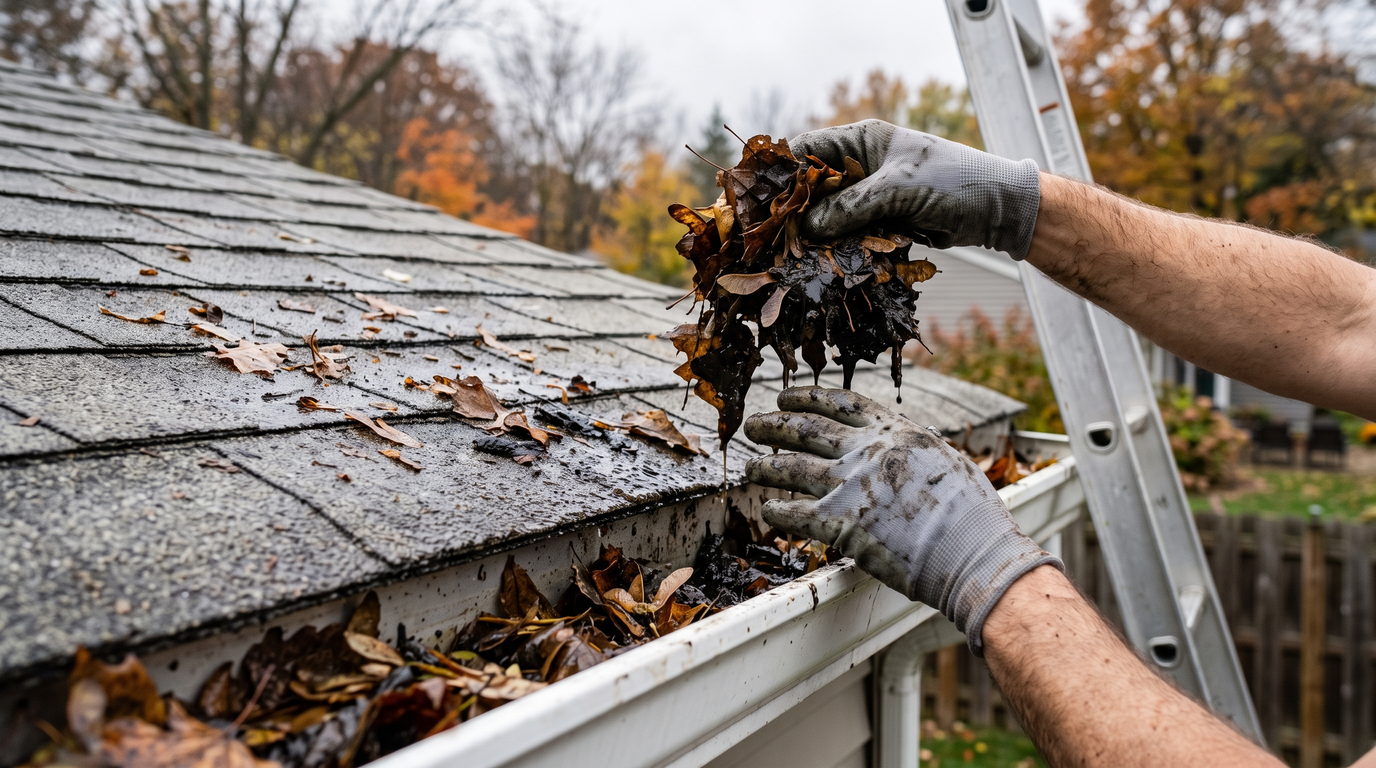
One cleaning is usually two — and that's not a failure
Trees don't drop on a schedule and they don't drop all at once. Maples and birches let go early and fast. Oaks hold their leaves stubbornly into December, and some hang on until the new spring growth pushes them off. If you have both in the same yard — most people do — there is no single day when the gutters are done filling.
So plan for a light pass when the early trees finish, and the real clean-out after the stubborn ones let go. If you only get one, make it the second one. A gutter that's clean in October and packed in December spends the whole winter full; a gutter cleaned once in late November goes into the freeze empty, which is the only thing that actually matters.
How to know your trees are done
Stop counting weeks and look up. When you can see sky through the branches and a genuinely windy day no longer leaves a fresh layer on the driveway, drop is finished for practical purposes — typically two to three weeks after peak color where you are. That's your window, and it's the same window as the last mow, which is convenient: do both the same weekend and the yard is closed for the season.
Why this matters more than it looks like it should
A clogged gutter isn't a gutter problem. It's a foundation problem wearing a gutter costume.
A packed trough overflows at the fascia, which soaks the board the gutter is screwed into — which is how gutters end up pulling away from the house. The water that gets past lands in a concentrated stream at the base of the wall instead of four feet out, and a roof sheds a startling amount of water: enough that a single serious storm can put hundreds of gallons against your foundation in exactly the wrong place. That's the actual mechanism behind a lot of wet basements, and it costs vastly more to fix than an afternoon on a ladder.
In cold climates there's a second failure mode. Standing water in a blocked gutter freezes, and the ice gives the next melt nowhere to go, so water backs up under the shingle edge and finds the sheathing. Ice dams have more to do with attic heat loss than with gutters — that's the honest version — but a gutter full of frozen leaf mash is a reliable way to turn a marginal roof edge into a leaking one.
Step 1
Set the ladder like you plan to survive it
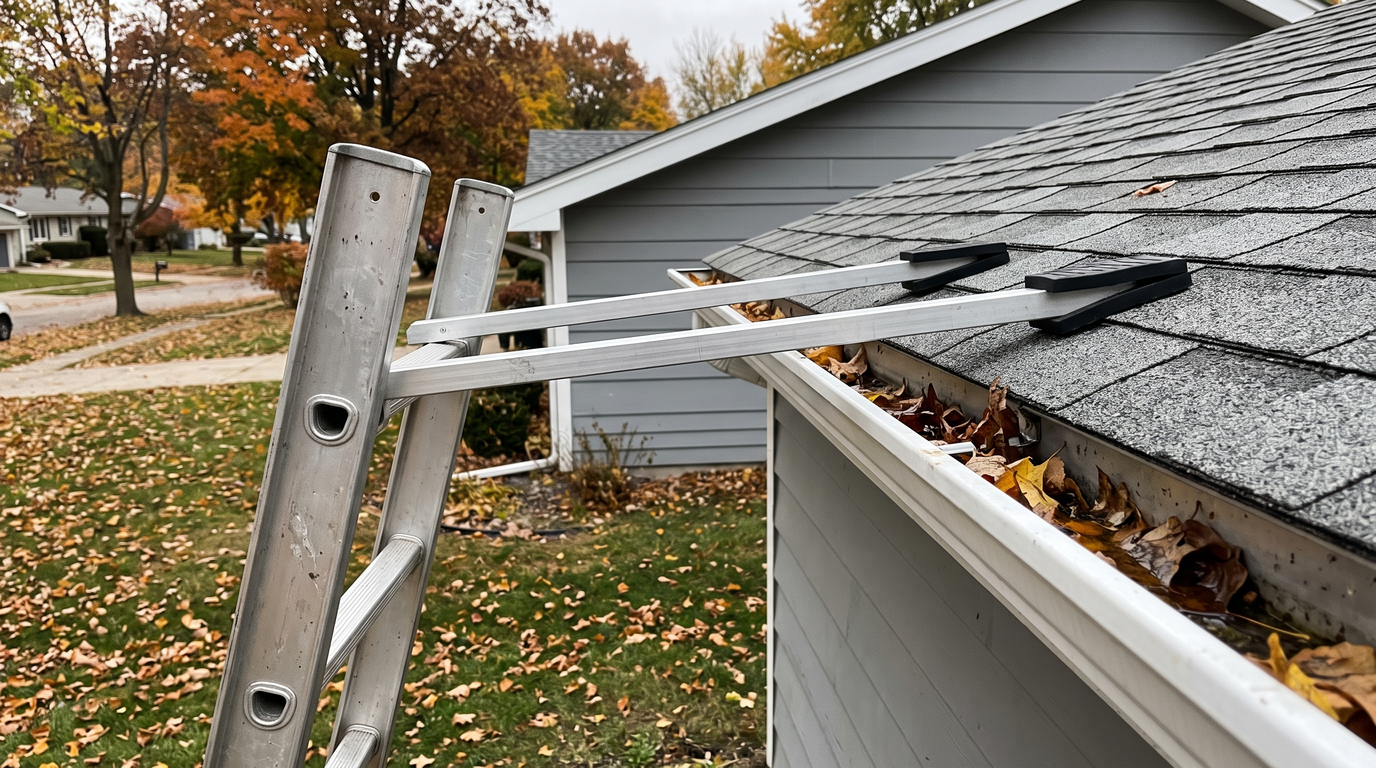
This is the part of the job that actually hurts people. Ladder falls send tens of thousands of Americans to emergency rooms every year, and gutter cleaning is one of the classic settings — not because ladders are exotic, but because the work invites the exact behavior that drops you: reaching sideways for one more armful instead of climbing down and moving the ladder six feet.
- Use an extension ladder, not a stepladder. A stepladder leaned against a house is unstable in the one direction you'll be pushing it.
- Four to one. For every four feet of height up to the contact point, the base sits one foot out from the wall. Too steep and it tips back; too shallow and the feet slide out.
- Three feet above the roof edge so there's something solid to hold at the top — and firm level ground underneath. A plywood scrap under the feet on soft lawn; never a stack of anything.
- Add a standoff stabilizer — the U-shaped arm that holds the rails off the wall. It's the best thirty-odd dollars in this whole article: it keeps your weight off the gutter (leaning a ladder straight onto aluminum is how gutters get dented and un-pitched), widens the contact points, and gives you room to actually work.
- Belt buckle between the rails. If your navel passes outside the ladder rails, you've gone too far. Climb down. Move it. Every time.
Two conditions where you stop
Wet or windy is not a gutter day — slick rungs and a ladder acting as a sail are the two most common ways this goes wrong. And if the ladder would have to stand on a slope, on a deck, or on anything but firm level ground, or if the run is on a second story you can't reach with solid footing, that's the job telling you it isn't yours. There is no version of this article where a clean gutter is worth a fall.
Step 2
Scoop first, hose second
The instinct is to blast everything out with water. Resist it. A hose turns a scoopable pile of wet leaves into sludge that packs itself into the downspout, and now you have a harder job than the one you started with.
Start next to a downspout and work outward, so the debris you're moving never travels toward the opening. A plastic gutter scoop is shaped for the trough and won't gouge the seams the way a metal trowel does — and gouged seams are how gutters start leaking at the joints a year later. Drop what you pull into a bucket hung off the ladder, or onto a tarp below if you'd rather rake it up once at the end. Gloves, obviously: gutter debris is a slurry of grit, shingle granules, and whatever the squirrels contributed.
Step 3
Flush it — and go watch the bottom of the downspout
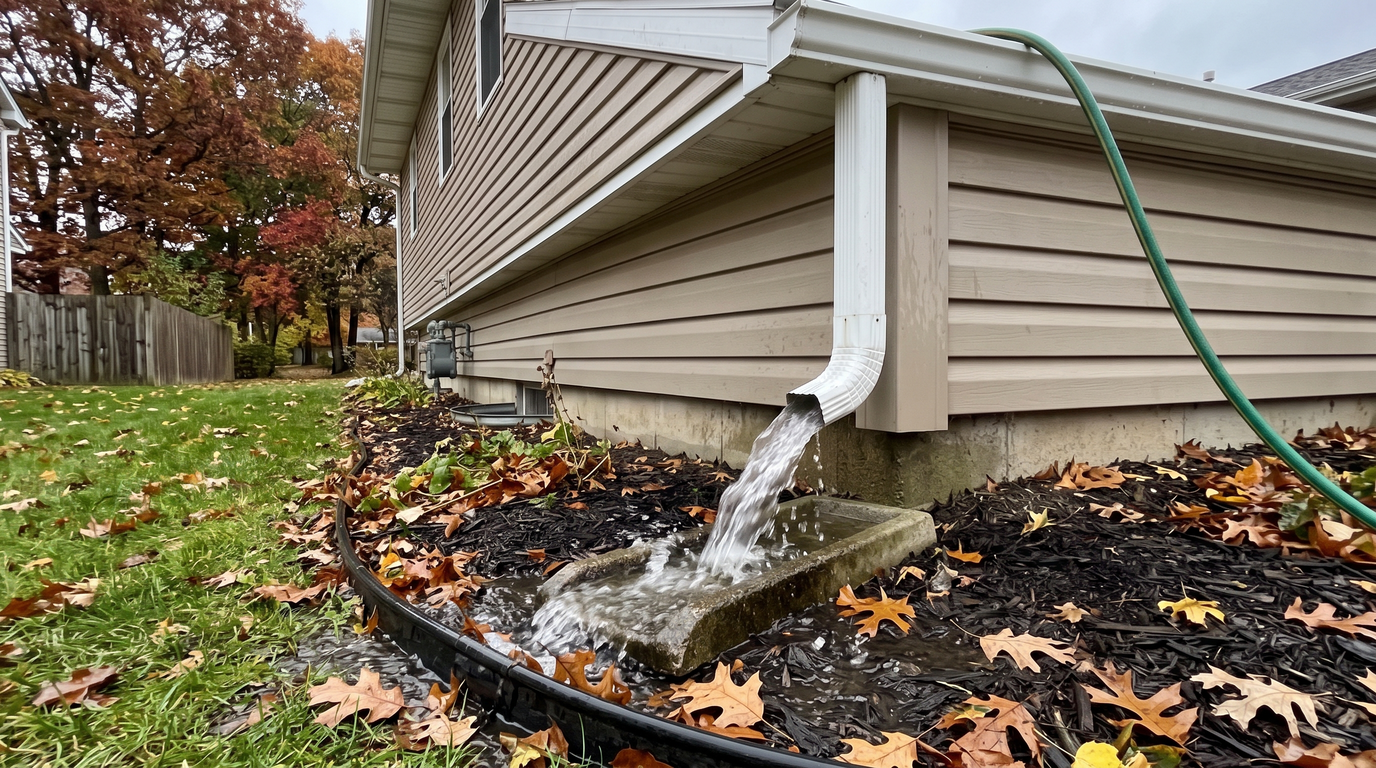
With the solids out, run a hose from the far end of the run and then go look at where the downspout lets out. This is the actual test, and it answers three questions at once:
- Strong flow out the bottom: the run is clear and this section is done.
- A trickle, or nothing: there's a clog in the downspout — nearly always at the elbow where it turns at the top, or at the bottom bend. Tap along the pipe and listen for the dull spot.
- Water sheeting over the front lip while the downspout barely runs: the gutter isn't draining toward the outlet. Either it's sagging between hangers or it was hung with too little pitch. The trough should fall roughly a quarter inch every ten feet toward the downspout.
For a stubborn downspout, work from the bottom up: feed the hose in at the lower opening so the clog gets pushed back the way it came instead of driven deeper into the elbow. A gutter wand — the long curved hose attachment — handles the top-side rinse from a steadier position on the ladder and lets you reach a few feet along the run without moving.
Step 4
Fix what the flush exposed
Cleaning is maintenance. This step is the part that actually prevents damage, and it's the one people skip because the gutters already look fine from the ground.
Re-seat any hanger that's pulled loose — a gutter sagging slightly in September holds standing water all winter, and standing water is weight, which makes the sag worse. Confirm every downspout discharges at least four feet from the foundation; a $12 extension or a splash block is the cheapest foundation insurance sold. And while you're up at the roof edge, look at the first course of shingles and at the flashing anywhere something penetrates the roof, because you will not have this view again until spring.
DIY or hire it out? An honest answer
This is a genuinely reasonable thing to pay for, and the deciding factor usually isn't money.
Expect roughly $150–$350 for a typical single-family home, more for height, steep pitch, or long runs. Get the quote in writing, confirm they haul the debris away rather than leaving it in your beds, and ask whether they flush and check the downspouts or only scoop the troughs — that difference is most of the value. It's the same calculus as knowing which plumbing jobs to hand off: the fee buys the right equipment and somebody else's risk.
Gutter guards: the honest version
Every homeowner with trees eventually asks whether guards will end this chore forever. The honest answer is no — no product on the market makes gutters maintenance-free, and an installer who tells you otherwise is selling. What good guards actually do is convert a scooping job into an inspection job. If you have heavy tree cover, that trade can be genuinely worth it.
The number that decides it
Compare the guard quote against what you'd actually spend on cleanings over ten years. Two pro cleanings a year at $200 is $4,000 a decade, against which a $2,500 micro-mesh install is a straightforward win. One easy DIY cleaning a year on a single-story ranch is a few hours and a bucket, and no guard on earth pays that back. Same product, opposite answers — and the variable is your trees and your roof, not the brochure.
What not to do
- Don't lean the ladder on the gutter. Aluminum dents under your weight, and a dented gutter no longer drains toward the downspout. That's what the standoff is for.
- Don't pressure-wash the gutters. It drives grit under the shingle edge, blows out seam sealant, and turns a loose clog into a packed downspout. Garden-hose pressure is the right tool.
- Don't work off the roof instead of the ladder. Standing on a slope above an open edge to reach down into a gutter is worse than the thing you were trying to avoid.
- Don't skip the downspout check. A spotless trough feeding a blocked downspout still overflows — you did the visible half of the job and none of the useful half.
- Don't do this alone at height. Someone who knows you're up there, ideally footing the ladder, is free and changes the worst-case outcome entirely.
The short version
Wait until your trees are actually bare, not until the calendar says fall. Set the ladder properly and move it instead of reaching. Scoop before you flush, then go watch the downspout, because that's the test that tells you whether you fixed anything. Re-seat the sags and check the discharge distance while you're up there. And if the setup makes you uneasy at any point, that's a $200 problem, not a fall.
Do it the same weekend as the last mow and the gutters, the lawn, and the season all close out together — which is exactly what the fall lawn schedule has been building toward.