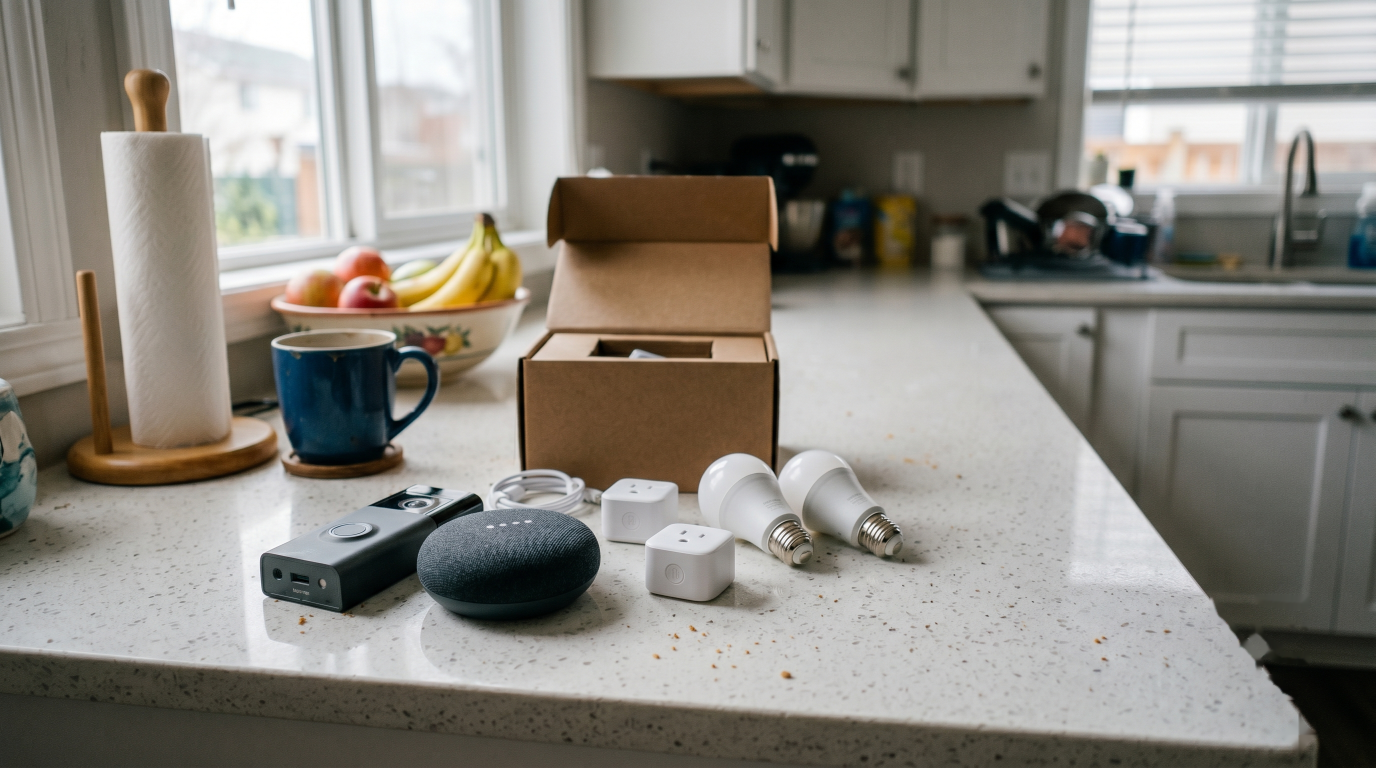
Somewhere in my office closet there's a cardboard box I think of as the gadget graveyard. It holds a smart air-quality monitor I checked twice, a Wi-Fi-connected outlet strip that lost its mind every time the router rebooted, a motion-sensing night light that needed its own app, and a "smart" garage door module I never trusted enough to actually use. Together they cost a few hundred dollars, and their combined contribution to my life has been zero.
I'm telling you about the box up front because the smart home industry would very much like you to fill one of your own. Walk the aisle at any big-box store and everything is smart now — bulbs, locks, blinds, faucets, refrigerators that put a touchscreen where the magnets should go. Some of it is genuinely useful. Most of it is a solution wandering around looking for a problem. After a couple of years of buying, returning, and actually living with this stuff, I can tell you the dividing line is surprisingly clean — and that a starter kit worth owning costs about $250, not $2,500.
The one-question test
Before buying any smart device, ask: "What does this do for me on a normal Tuesday, without me touching an app?" If the honest answer is "nothing," it's a toy, not a tool. Every device below passes that test. The gadget graveyard is full of things that didn't.
What Makes a Smart Device Actually Worth It
The devices that survive in my house all share four traits, and I'd hold any new purchase to the same standard:
- It works automatically. The win comes from a schedule, a sensor, or a routine — not from you pulling out your phone. If you have to open an app to use it, it's just a remote control with extra steps.
- It still works when the internet doesn't. A thermostat should hold its schedule and a lock should still take a key when the Wi-Fi hiccups. Anything that turns into a brick offline is a liability.
- No subscription required for the core job. Optional cloud extras are fine. A monthly fee just to use the thing you bought is not.
- It solves a problem you actually have. Forgotten lights, a house that's hot when you get home, packages on the porch, a water heater that could quietly flood the basement — real problems. "My fridge can't tweet" is not a real problem.
With that filter in place, here's the starter kit — in the order I'd buy it.
Worth It #1
A Smart Thermostat (Still the Undisputed Champion)
If you buy exactly one smart device, it's this, and it isn't close. Heating and cooling is 40–50% of a typical utility bill, and a smart thermostat is the only gadget on this list that directly manages it. Set a schedule, let it ease off while you're asleep or out, and it quietly pays for itself — typically inside two years, faster if your current setup is "set it to 70 and forget about it."
The two names that matter are still Nest and ecobee, and for most homes the mid-range model of either is the sweet spot — the flagship versions mostly add a nicer screen. The install is a legitimate DIY job, with one wrinkle (the C-wire) you should understand before you buy. I wrote up the whole thing, wiring photos included, in the smart thermostat install guide.
Budget: $130–$250. The one device here that earns money instead of just convenience.
Worth It #2
Smart Plugs (The Best $25 in Smart Home)
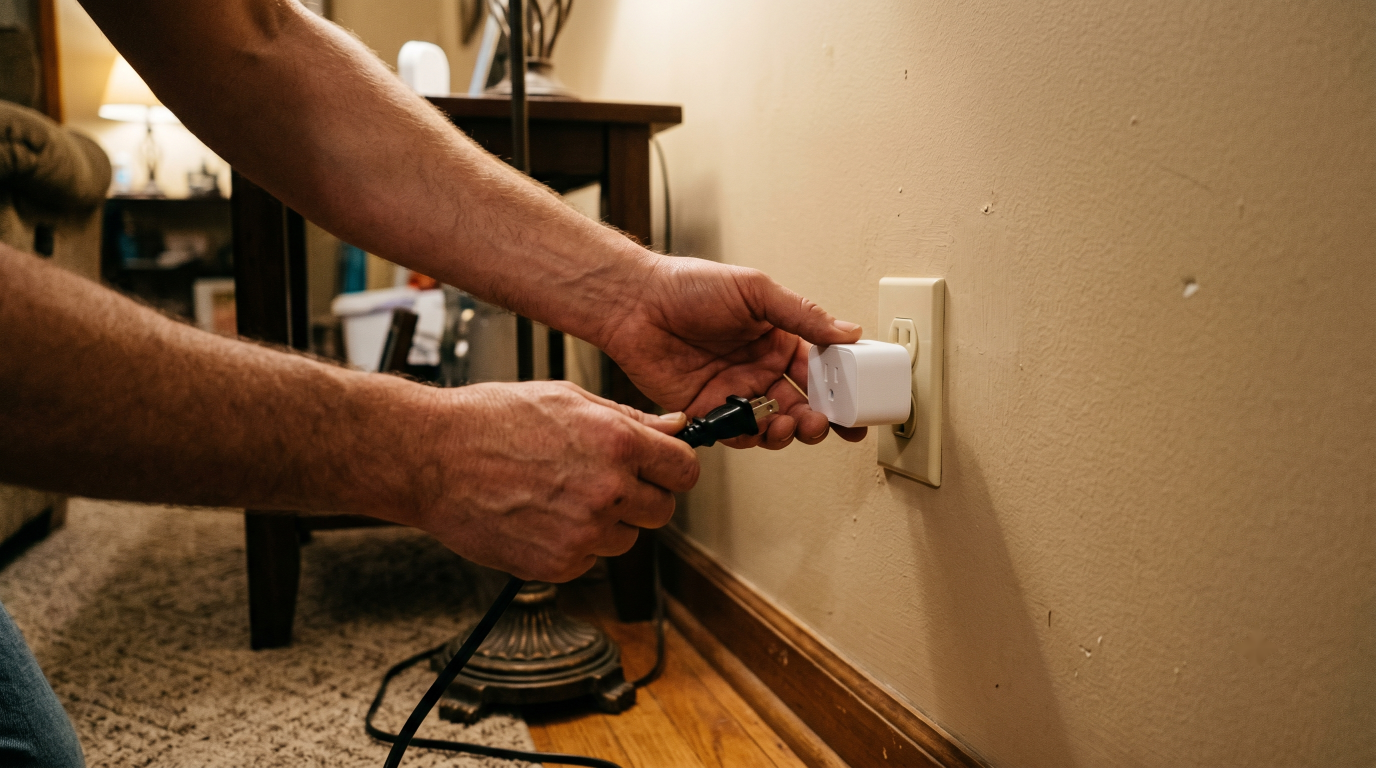
Smart plugs are the cheapest way to find out what home automation is actually good for. A four-pack of name-brand smart plugs (Kasa and Wyze are the reliable budget picks) runs $25–$35, and each one turns whatever you plug into it — lamp, fan, coffee maker, space heater, holiday lights — into something that runs on a schedule.
The killer use case is boring: lamps. Two living room lamps on a sunset-to-11pm schedule means the house never sits dark — you stop walking into a black living room carrying groceries, and when you travel, the lights behave exactly like someone's home, which is better security than most $200 gadgets deliver. After that you'll find your own uses: ours run the porch string lights, a grow light, and a box fan in the garage. Several models also track energy use, which is a fun way to discover what that old chest freezer really costs you per month.
Budget: $25–$35 for four. Pound for pound the best value on this list.
One safety note
Check the amp rating before putting a space heater on a smart plug — heaters pull serious current, and a bargain-bin plug rated below 15 amps is a fire risk. Name-brand 15A plugs handle it fine, but a heater that can switch on unattended deserves a second thought anyway. Lamps and fans? Zero worries.
Worth It #3
A Video Doorbell (The One Camera Most Homes Actually Need)
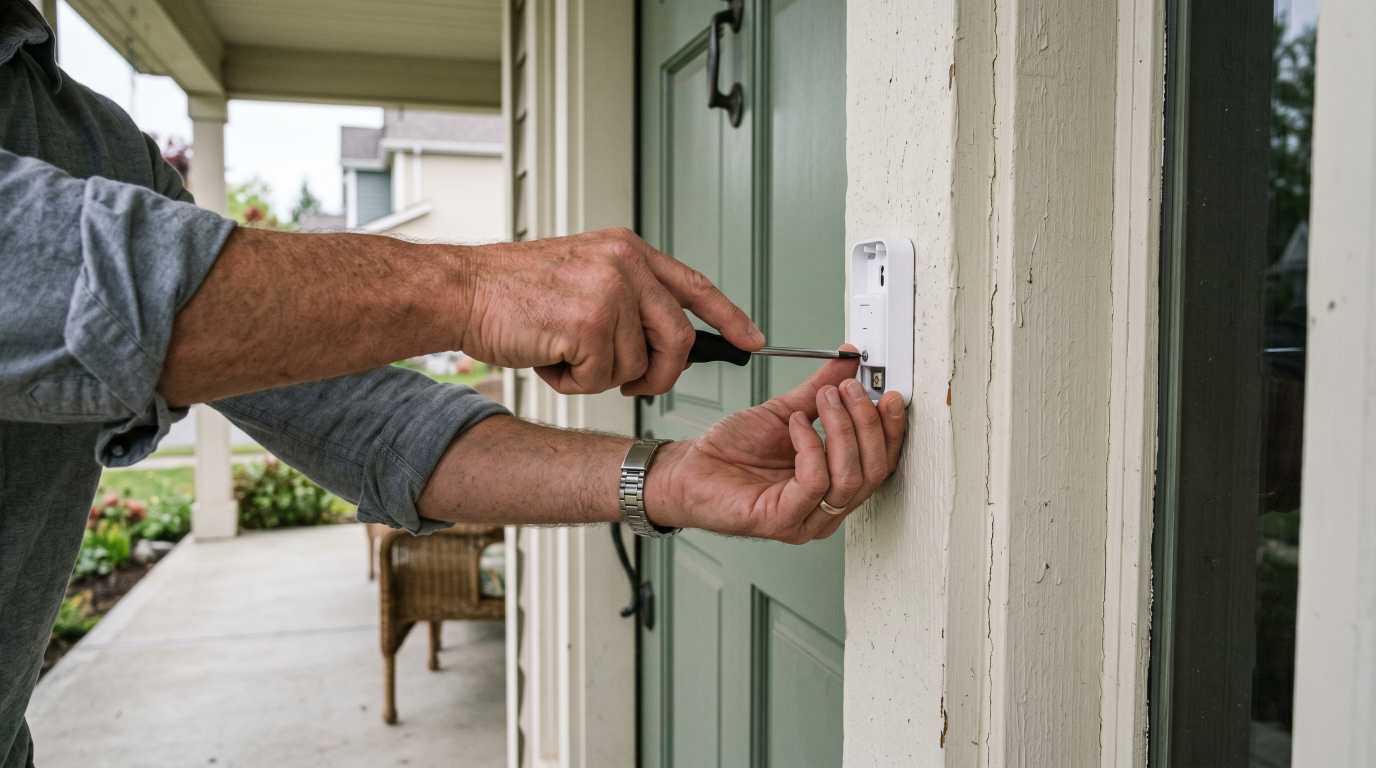
You don't need cameras covering every angle of your property like a casino. For a typical house, one camera position earns its keep: the front door. That's where packages land, where solicitors knock during dinner, and where anyone approaching the house actually goes. A video doorbell covers all of it — you see the delivery confirmation, you answer the door from the backyard or the office, and porch pirates move along to an easier target.
Battery models install in ten minutes with two screws and need a charge every couple of months; wired models replace your existing doorbell button and never need charging (the wiring is genuinely simple — two low-voltage wires, no electrician). The honest catch with this category is subscriptions: Ring and Nest both push monthly plans for cloud video history. Live view and motion alerts work free, which covers most of the actual value — but if recorded clips matter to you, factor the $5–$10/month in, or look at brands like Eufy that store video locally with no fee.
Budget: $60–$150. Skip the four-camera bundle until you've lived with the doorbell.
Worth It #4
Water Leak Sensors (The Unsung Hero Nobody Buys)
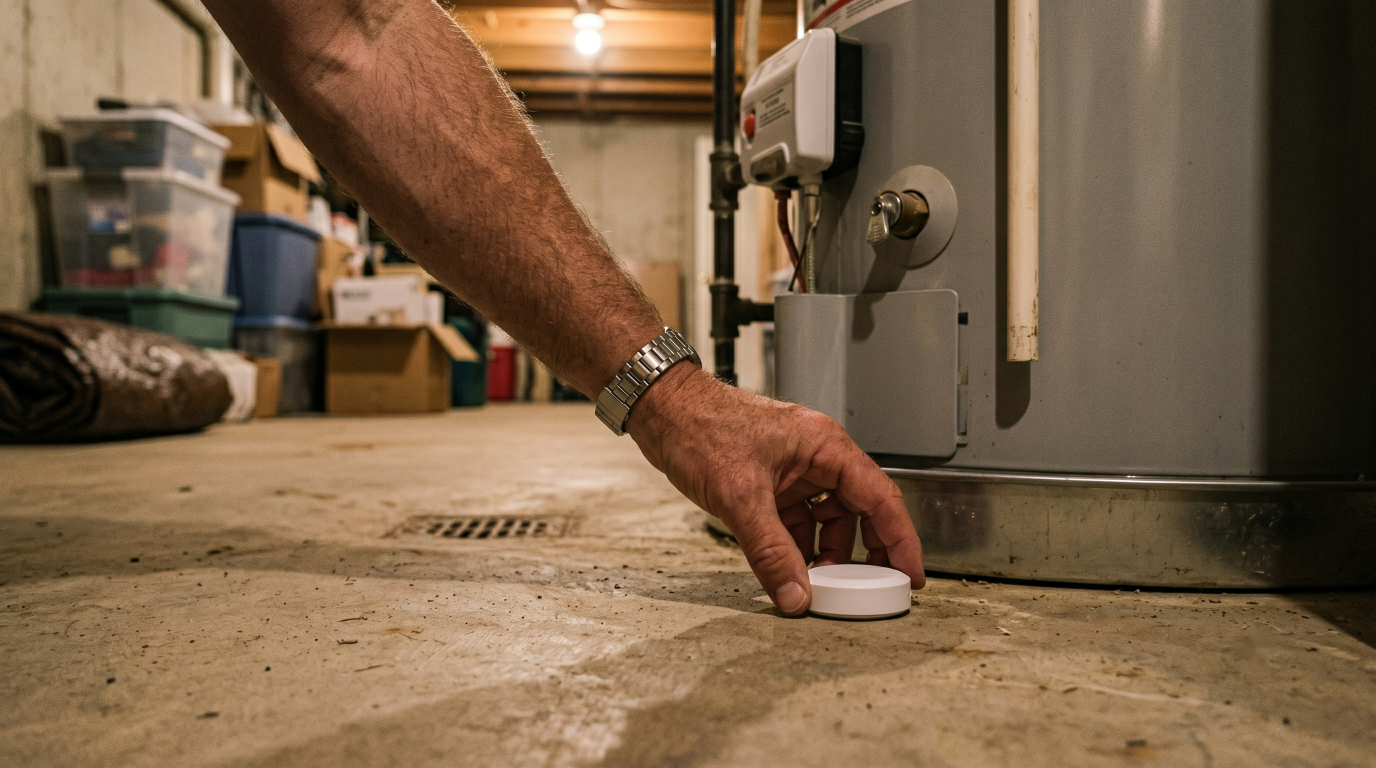
This is the least exciting device on the list and the one I push hardest on friends. A Wi-Fi water leak sensor is a hockey puck that sits on the floor and does absolutely nothing — until water touches it, at which point it screams and sends your phone an alert. That's the entire product, and it's brilliant, because the average insurance claim for water damage runs north of $12,000 and the most common sources are completely predictable: the water heater, the washing machine hoses, under the kitchen sink, and the basement low spot.
Put one puck in each of those places — a three-pack runs $30–$50 — and you've covered the four most likely five-figure disasters in your house for less than a dinner out. A water heater usually leaks slowly before it lets go; a sensor turns that from "discover it when the carpet squishes" into "get a phone alert Tuesday morning and shut the water off at the valve you already know how to find."
Budget: $30–$50 for three. The best disaster-per-dollar ratio in this entire category.
Worth It #5
A Few Smart Bulbs — or Better, Smart Switches
Smart lighting is genuinely good; whole-house smart lighting is genuinely expensive. The trick is knowing which form to buy:
- Smart bulbs ($8–$15 each) make sense in lamps — anywhere the bulb is the fixture and nobody flips a wall switch. Bedside lamps that dim warm in the evening are the single nicest quality-of-life upgrade here.
- Smart switches ($15–$25) make sense for ceiling fixtures — one switch controls all six recessed cans, costs less than six smart bulbs, and keeps working like a normal switch for every guest, babysitter, and family member who will absolutely not be opening an app to turn on the kitchen lights.
The classic mistake is filling ceiling fixtures with smart bulbs and then discovering the fatal flaw: when someone flips the wall switch off, smart bulbs go dumb. They have no power, no schedule, no app control — and now the house is arguing about leaving switches on. Start with two or three bulbs in actual lamps. If you find yourself wanting more, that's when a smart switch for the main living areas is worth the slightly bigger job of installing it (it's a 20-minute swap, same skill level as replacing an outlet — breaker off first, always).
Budget: $30–$50 to start.
What to Skip (For Now)
None of these are scams — they're just the wrong place for starter money, because they fail the Tuesday test or the price-to-problem math doesn't work yet:
| Device | Why it can wait |
|---|---|
| Smart appliances (fridge, oven, washer) | You pay a $300–$800 premium for notifications you'll silence in a week. The appliance's actual job is unchanged. |
| Smart locks | Genuinely useful for rentals and frequent dog-walkers/sitters — but for most homes a $30 mechanical keypad deadbolt delivers 90% of the benefit with zero batteries-died-at-the-door risk. |
| Smart blinds | Lovely, and $150–$300 per window. This is the last upgrade, not the first. |
| Whole-room LED strips and panels | Decor, not utility. Fine to want; don't confuse it with the starter kit. |
| Smart faucets, toilets, mirrors | The Tuesday test fails instantly. Your faucet already has an excellent interface. |
| Indoor security cameras everywhere | Beyond the doorbell, most homes get more security from the lamps-on-schedule trick than from camera #4. |
The Ecosystem Question (Shorter Answer Than You'd Think)
People stall on Alexa vs. Google vs. Apple like it's a marriage. It's not — here's the practical version. Pick whichever assistant is already in your house or on your phone: Alexa if you have Echo speakers, Google if you're an Android/Nest family, Apple Home if you're all-in on iPhones. Then buy devices that support it (nearly everything supports the first two, and the Matter standard has spent the last couple of years making the logos on the box matter less and less).
A smart speaker or display is a nice-to-have hub for voice control — "lights off" at bedtime genuinely beats finding a phone — and they're routinely $25–$35 on sale, so there's no need to pay full price. But it's the garnish, not the meal. The schedule-and-sensor automation above all works without ever saying a word to anything.
The Starter Kit, Itemized
Here's the whole list in one place — what I'd actually buy first, roughly in order:
| Device | Rough cost | What it earns you |
|---|---|---|
| Smart thermostat (mid-range Nest or ecobee) | $130–$180 | Real money off every utility bill |
| Smart plugs, 4-pack | $30 | Lights on schedule, away-from-home security |
| Video doorbell (battery) | $60–$100 | Packages, visitors, porch security |
| Water leak sensors, 3-pack | $40 | Five-figure disaster insurance for $40 |
| 2–3 smart bulbs for lamps | $30 | Evening light that runs itself |
| Total | ~$290–$380 | Every dollar passes the Tuesday test |
Watch for sales and that number drops fast — smart home gear is heavily discounted around Prime Day (July) and Black Friday, and the thermostat is frequently $40–$50 off. Many utility companies also offer rebates on smart thermostats, sometimes covering half the price; it's a two-minute search on your utility's website before you buy.
The Honest Caveat
The smart home stuff that works, works because it's quiet infrastructure — a thermostat saving money while you ignore it, lamps that come on by themselves, a puck on the basement floor doing nothing for three years until the night it matters. None of it will transform your life, and anyone selling transformation is selling the box in my office closet.
It's also worth saying: a smart thermostat optimizes your heating and cooling, but it can't fix a leaky house. If the AC runs constantly, the bigger wins are usually unglamorous — weatherstripping the doors, a fresh HVAC filter, and a weekend energy audit to find where the cold air is escaping. Do those first and the thermostat's savings stack on top. Smart is good. Sealed is better. Both is the goal.