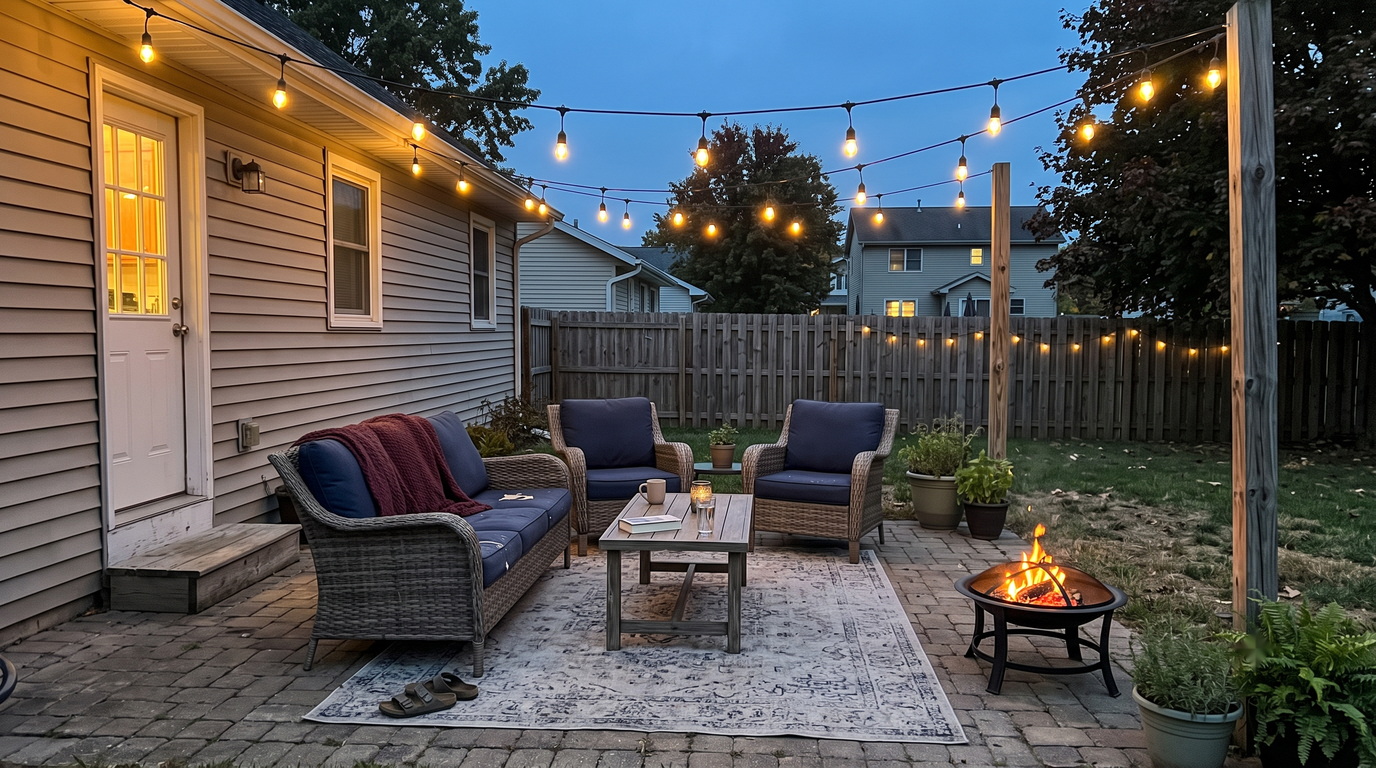
Here's the math nobody runs: adding a room to your house costs somewhere north of $50,000. Meanwhile there's a slab of concrete or a rectangle of deck boards out back that becomes a fully functional room for a few hundred dollars — one that seats eight, hosts dinner, and doesn't need drywall. The backyard is the cheapest square footage you will ever add to your house, and July is when it pays out.
The trick is that outdoor spaces fail for predictable reasons: no shade at 4 p.m., no light at 9 p.m., mosquitoes at dusk, and nowhere comfortable to sit at any hour. Fix those four problems and people migrate outside on their own. Everything below targets one of them, and none of it needs a contractor. Unlike the indoor version of this list, there's no price ceiling here — some of these are $30 fixes, and a few are genuine investments that earn it, because this is the room you'll actually live in from May to October.
First: Ten Minutes of Planning, Zero Dollars
Before anything gets bought, go stand in the backyard at the two times you'd actually use it — once mid-afternoon, once just after sunset — and answer three questions. Where does the sun land at 4 p.m.? That's where shade goes. What do you see when you sit down? If the answer is the neighbor's trash cans or their kitchen window, that's where privacy goes. Where's the nearest outlet? That decides where the lights, the fan, and the speaker can live without a extension-cord booby trap across the walkway. Ten minutes of this beats $500 of returns.
Then pick the room's footprint and commit to it. An outdoor living area works like an indoor one: it wants a defined floor, a focal point (the fire pit or the table), and seating arranged so people face each other — not a scatter of chairs along the fence line like a waiting room. Most patios want one zone; a big deck might support two (dining near the door, lounging at the far end). Everything on this list slots into that plan. Nothing on this list fixes the lack of one.
1. String Lights: The Highest-Impact $30 in the Yard
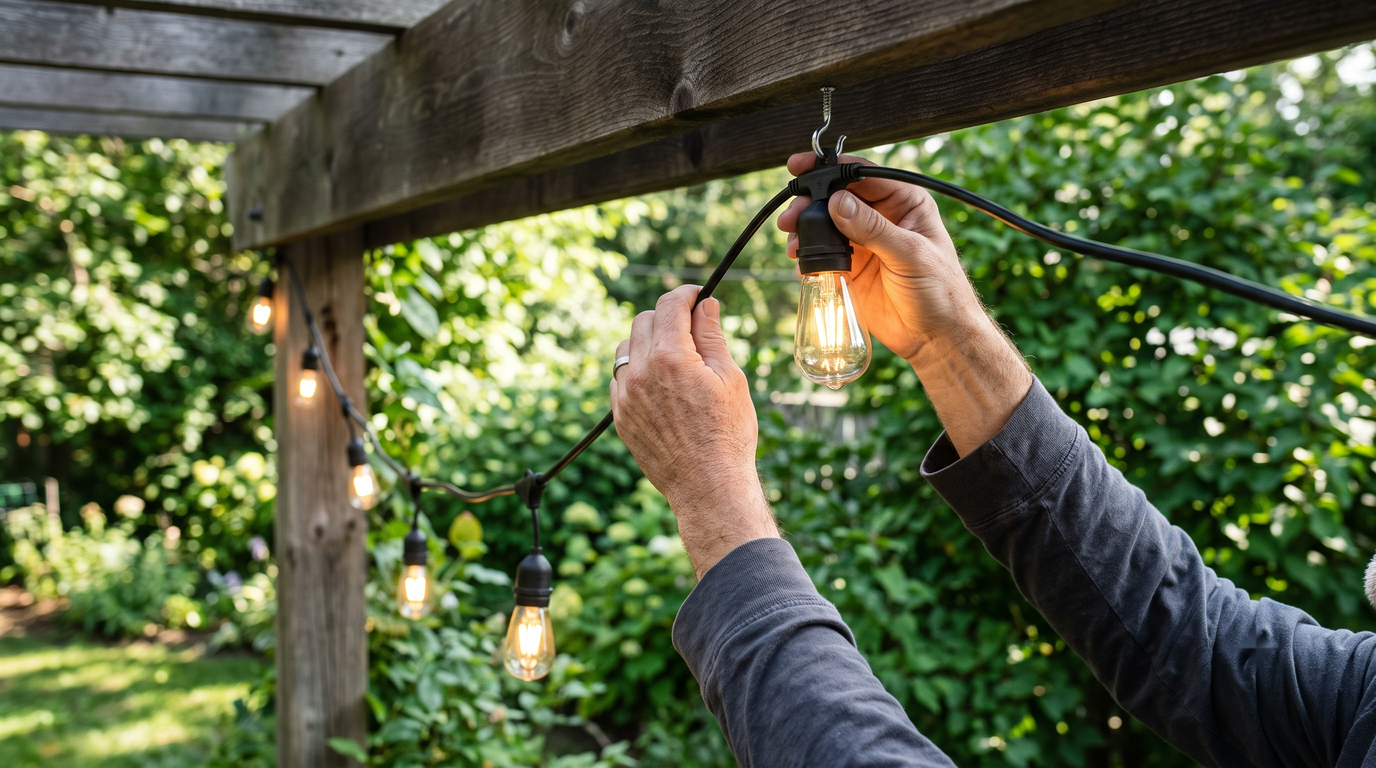
There's a reason every restaurant patio on earth uses these: overhead warm light is what makes an outdoor space read as a room instead of a yard you happen to be standing in. A 48-foot strand of LED cafe lights runs $25–40, and the LED part matters — they draw almost nothing, don't shatter, and survive winter if you're too lazy to take them down (you will be). Hang them with screw hooks and a slight swag between points — taut lines look institutional, a little droop looks like Tuscany. No structure to hang from on the far side? A planter bucket, a bag of concrete, and a wooden post is the classic DIY fix, and it takes an hour.
Two details separate a good install from a great one. First, the pattern: for a square-ish patio, run the lights from the house to two posts in a V or W rather than one straight line — the crisscross overhead is what creates the ceiling effect. Second, the power: use an outdoor-rated extension cord if you must, but the best money you'll spend is a weatherproof smart plug ($15) so the lights come on at sunset by themselves. Lights you have to remember to turn on get turned on for company; lights on a schedule get lived under every night. One warning: buy strands rated for outdoor use with the bulbs included — indoor fairy lights last exactly one thunderstorm.
2. An Outdoor Rug (Yes, It Changes Everything)
This is the one people skip because it sounds decorative, and then the rug shows up and suddenly the patio has a living room in it. A rug does outside exactly what it does inside: it declares "this zone is the room," pulls the chairs and table into a composition, and hides forty years of concrete staining while it's at it. An 8x10 polypropylene outdoor rug is $60–90, sheds rain, and hoses clean. Size up, not down — a rug all four chair legs can't sit on reads as a bath mat that got lost.
Material matters more outside than in. Polypropylene (sometimes labeled olefin) is the only answer for a rug that lives uncovered — it's plastic pretending to be wool, which is exactly what you want when it rains sideways. The jute and natural-fiber ones look great in photos and grow mold in real life. Two practical notes: put rug grippers under the corners so the first gusty afternoon doesn't fold it over the furniture, and once or twice a season, hang it over the railing and hose both sides — dirt that sits under a rug on wood decking traps moisture against the boards, and that's how you grow the gray spots you'll be sanding out in September.
3. Real Shade, Because 4 P.M. Is Undefeated
Every unused patio has the same autopsy result: full western sun exactly when people want to sit outside. The fix scales with budget. A shade sail is $35–60 and turns the sun into dappled nothing — mount it at an angle, one corner lower, both for looks and so it sheds rain instead of collecting it. A cantilever umbrella ($80–150) is the moveable-feast option — the offset arm means no pole in the middle of the conversation. And if the backyard has earned a real commitment, a hardtop gazebo or wood pergola ($800–2,000, a weekend with a helper to assemble) is permanent shade, a mounting point for the string lights and fan, and the closest thing to actually adding a room without pulling a permit.
The installation details are where shade projects go sideways. Shade sails pull hard in wind — anchor them to structure (a ledger-mounted eye bolt into framing, a 4x4 post set in concrete), never to a fence picket or gutter, and use turnbuckles so you can crank the sail drum-tight; a loose sail flaps itself to death in a season. Umbrellas live or die by the base: a 9-foot cantilever wants 100+ pounds of ballast, and the $25 plastic base that came with it is how umbrellas end up in the neighbor's yard. Gazebos need anchoring into the patio surface or ground stakes rated for the job — an unanchored hardtop is a kite with a roof. Whatever you choose, shade is the difference between a space that's usable from 10 to 2 and one that works all day.
4. A Fire Pit That Doesn't Chase You With Smoke
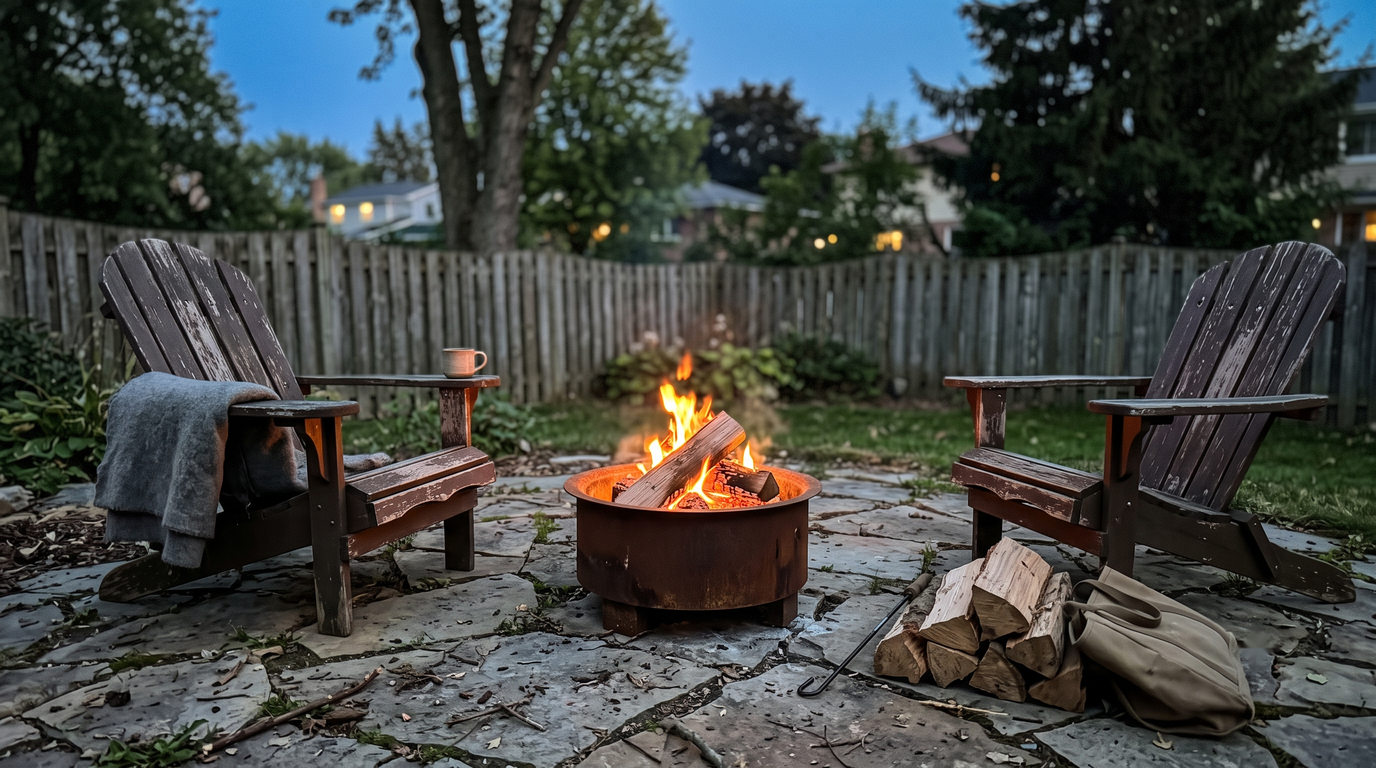
A fire pit converts your patio's dead season — after dark — into the main event, and it's the single best cure for everyone drifting back inside at 8:30. The $60 steel bowl from the hardware store works, with the classic catch: wind shifts, smoke follows someone around the circle all night, musical chairs ensues. The smokeless designs ($200–300) actually deliver on the name — double-wall airflow burns off the smoke before it escapes — and they're the rare premium outdoor product that earns it. If wood fires aren't your ritual (or your HOA's), a propane fire table ($300–600) lights with a knob, dies with a knob, and doubles as the coffee table.
The safety rules are short and non-negotiable: pavers or gravel underneath (never directly on a wood deck or dry grass — if the deck is the only option, buy a fire-pit heat shield mat and keep the fire small), ten-plus feet from the house and anything overhanging, and a check of your town's open-burning rules before the first marshmallow. Burn seasoned hardwood only — construction scraps and treated lumber put genuinely toxic smoke into your seating circle, and green wood is where the smoke complaints come from even in a smokeless pit. Keep chairs about four feet back, keep a bucket of sand or a hose within reach, and when the night ends, let it burn down rather than dousing a hot steel pit with water — thermal shock warps the bowl. A spark screen is $25 of cheap insurance if your yard runs dry in August.
5. Win the Mosquito War (Or Lose the Evening)
None of the above matters if everyone's slapping their ankles by 8 p.m. The two-part fix: cut the population, then defend the patio. Population control is a walk around the yard dumping standing water — plant saucers, clogged gutters, the kiddie pool, the wheelbarrow — because mosquitoes breed in a bottle cap's worth of water and they don't commute far. The full battle plan, sprayer and all, is in the yard insect control guide.
Patio defense is easier than people think, because mosquitoes are terrible fliers. A box or pedestal fan pointed across the seating area defeats them for the cost of moving air — which you wanted in July anyway; a gentle breeze at ankle height beats any candle ever made. For the perimeter, a spatial repeller ($25) quietly clears a 20-foot zone with no spray and no citronella smell — set it out 15 minutes before you sit down, slightly upwind. And save your money on the citronella plants and ultrasonic gadgets; the first smells nice and does nothing measurable, the second doesn't even smell nice. Between the fan and the repeller, dusk stops being an eviction notice.
6. Give the Grill a Real Workstation
Every grill setup accumulates the same sad still life: a plate balanced on the railing, tongs on a windowsill, sauce bottle on the ground. A grill cart or prep table ($60–120) fixes it: prep surface, hooks for tools, a shelf for the platter that carries everything in one trip. It's the difference between grilling feeling like a hassle and feeling like the reason you bought the house.
Lay the station out like a tiny kitchen: a landing zone on each side of the grill — raw on one side, cooked on the other, so the chicken never comes back to the plate it left on — tools hanging where your hand falls, and a clip-on grill light ($15) because half of summer grilling happens after dusk and phone-flashlight-in-the-teeth is not a technique. While you're re-homing the grill, check its clearances: at least two feet from siding and railings — vinyl siding warps at a distance that surprises people — and never under an overhang or umbrella. If the grill itself is the weak link in this station, that's a bigger conversation we'll be having on this site very soon.
7. Privacy Where You Actually Need It
You don't need to fence the property line — you need to block one sight line: the neighbor's kitchen window, the street, the gap where the yards meet. Solve it like furniture, not construction: a row of three tall planters with ornamental grasses or arborvitae, a freestanding privacy screen ($60–100), or reed fencing zip-tied to an existing railing for $30. Enclosing even one side of a patio makes the whole space feel more like a room — same psychology as the rug, working vertically.
Plant choices deserve thirty seconds of thought before the nursery run. Ornamental grasses (miscanthus, switchgrass) hit five feet by midsummer, wave around attractively, and shrug off neglect. Arborvitae in planters gives you evergreen privacy but needs consistent water its first year — a pot dries out far faster than the ground. And the classic trap: bamboo. Clumping bamboo in a container is fine; running bamboo in the ground is a lifestyle decision your neighbors get a vote on, because in three years it will be their privacy screen too. If you're going the planter route, drag them into position before filling — a planted 20-inch pot weighs more than you want to discover it does.
8. Seating People Don't Politely Escape From
Be honest about the current chairs: if they're the stackable resin ones, guests are leaving early because their backs hurt, not because of the hour. The budget path: real cushions ($40–70 for a set) on the frames you already own, or two poly Adirondack chairs that live outside year-round and shrug off rain. The investment path: a proper conversation set ($400–900) — and this is the one place on this list where spending more genuinely changes how the space gets used, because a sofa outside is an invitation in a way four chairs never are.
Arrangement is free and matters as much as the furniture: seats facing each other no more than eight feet apart (past that, conversation dies and phones come out), every seat within reach of somewhere to set a drink, and the best view — the fire, the yard, the sunset — shared rather than hogged by one lucky chair. On materials, the short version: poly lumber and powder-coated aluminum are the set-it-and-forget-it options; steel rusts at every scratch; resin wicker is fine if the frame under it is aluminum, not more resin. Whatever you buy, the fabric rule is the same: solution-dyed acrylic or olefin with water-resistant fill — the bargain cushions grow a mildew colony by August. And a deck box ($60) to throw everything in when weather rolls through doubles as a side table and a bench.
9. Green It Up Without Signing Up for a Second Job
Plants are what make a patio feel alive instead of staged, and containers are the low-commitment way in: a few big pots (one dramatic plant each beats seven sad little ones), a couple of herb planters by the grill — basil, rosemary, mint, thyme — so seasoning dinner means reaching left. The nursery formula that always works is thriller-filler-spiller: one tall dramatic thing in the middle, mounding plants around it, something trailing over the rim. Buy the biggest pots you can stomach — big pots hold moisture longer, which directly translates to fewer dead plants and less guilt.
The failure mode is watering, because July containers dry out daily — sometimes twice daily on a west-facing slab. The fix is the same drip irrigation logic from the garden beds: a $30 kit with a timer waters the pots while you sleep, and it's honestly a fifteen-minute install for a patio's worth of containers. Use actual potting mix, not bagged garden soil (which compacts into a brick in a pot), and feed monthly — containers leach nutrients out the drainage hole with every watering. If this is the year the container garden graduates, the raised bed build is the natural next step, and the curb appeal guide covers the front-of-house version of all this greenery.
10. Backyard Movie Night (Cheaper Than You Think)
The finishing move. A weatherproof Bluetooth speaker ($30–60) handles the every-night version — music at dinner volume, not subdivision volume. The special-occasion version: a mini projector ($80–120), a white sheet clipped to the fence or a $25 blow-up screen, popcorn, and the string lights dimmed. Kids remember backyard movie nights for decades. Nobody remembers the fourth streaming service.
Expectations management, so the first movie night isn't a letdown: budget projectors need real darkness, so start the movie at full dusk, not golden hour — in July that means a 9 p.m. showtime, which is honestly part of the occasion. Pull the sheet or screen drum-tight (wrinkles read as waves on screen), put the speaker up near the picture so the sound comes from where people are looking, and run the projector off the same outlet strategy as the lights. If it becomes a tradition, a proper screen with a stand ($60–90) beats the sheet, and your neighbors will start finding reasons to walk by around 8:55.
Small Patio? Small Budget?
If you do exactly three things from this list, make them string lights, the fan, and cushions — about $110 total, and they solve light, mosquitoes, and comfort, which are the three reasons people go back inside. Everything else is compounding interest.
Five Ways to Waste Money Out Here
- Buying furniture before defining the room. Measure the zone, tape it out, then shop. The sectional that "looked small in the store" is the most-returned object in outdoor retail.
- Bargain cushions. Anything without a named fabric (solution-dyed acrylic, olefin) is a mildew farm with a pattern on it. One good set outlives three cheap ones.
- Extension-cord spaghetti. One outdoor-rated cord run safely along the house beats four indoor cords daisy-chained through the grass. If the patio has real electrical ambitions, one exterior GFCI outlet installed by an electrician (~$200) pays for itself in not tripping over things forever.
- Over-lighting. The goal is restaurant patio, not prison yard. Warm bulbs (2700K), hung high, on a schedule — and resist the floodlight except for security. If you can see the bulbs' filaments comfortably, you got it right.
- Skipping the boring maintenance. All of this sits on a deck or patio that still needs its barefoot check, its washing, and — if the boards have gone gray — a staining weekend come September. Furniture on a failing deck is a couch on a trampoline.
The Scoreboard
Frequently Asked Questions
What's the single cheapest way to make a patio feel finished? String lights plus a rug — about $100 combined. Light overhead and a defined floor are the two signals your brain uses to decide "this is a room," and everything else builds on them.
Can I leave all this outside year-round? The rug, poly furniture, and frames, yes. Cushions, the speaker, and the projector want to winter in the deck box or garage — it's not the cold that kills them, it's months of freeze-thaw moisture. The fire pit survives outside but lasts years longer with a $20 cover, because standing rainwater in a steel bowl is a rust program with a schedule.
I rent — how much of this can I take with me? Almost all of it. The only items that attach to the structure are the string-light hooks (tiny holes, easily filled) and a shade sail's anchors. Everything else — rug, umbrella, fire pit, fan, planters, furniture, screen — moves out when you do, which makes this list a better investment than almost anything a renter can do indoors.
What order should I do these in? Follow the failure points: light first (you'll use the space that same night), then bugs, then seating — those three make the patio livable. Shade next if afternoon sun is why you're not out there. The fire pit, plants, privacy, and movie rig are the compounding layers after that. The planning walk at the top of this article is still step zero.
Is any of this worth it for resale? Indirectly. Unlike a kitchen reno, a $500 patio setup doesn't appraise — but listing photos of a styled outdoor room absolutely change how a house shows, and most of this list rides along to the next house anyway. Buy it for the summers you'll use it; treat the staging value as a bonus.
Start with whichever item made you glance at your own backyard mid-sentence. The maintenance side of summer — the deck check, the AC, the wasp patrol — lives in the July checklist and the summer maintenance checklist; this list is the reward for keeping up with those. And if the deck boards themselves have gone gray and splintery under all these new string lights, hold that thought — a staining weekend is on the calendar for September, when the weather lets stain cure properly.