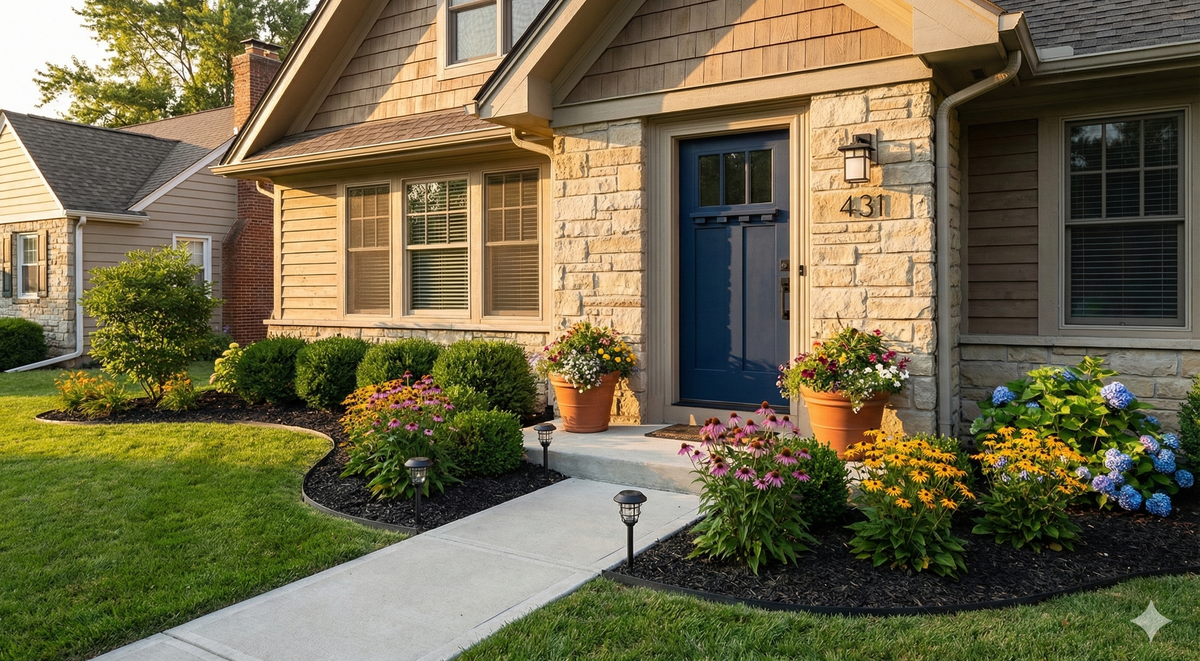
Last spring, I was standing at the end of my driveway looking at my house with what I can only describe as fresh eyes. I'd been living there for three years, so I'd stopped really seeing it. But that morning — maybe it was the angle of the light, or the fact that the neighbor across the street had just put in new landscaping — I saw what everyone else saw: a house that looked tired. Not falling apart, not ugly, just... neglected around the edges. Faded mulch. An overgrown bush blocking half the front window. A porch light that belonged in 1997.
The thing is, I'd been pouring money and weekends into the inside of the house — new bathroom fixtures, kitchen backsplash, that kind of thing. All good projects. But none of it was visible from the street, and the outside of my house was quietly making a bad first impression every single day.
Over the next few weekends, I worked through a series of small outdoor projects — nothing over $100, nothing requiring a contractor — and the transformation was honestly embarrassing. Embarrassing because it was so easy and I'd let it go so long. Neighbors I barely knew started commenting. My wife said it looked like a different house. All I'd done was pay attention to the details.
Here are the 10 projects that made the biggest difference, ranked roughly by impact-per-dollar. Every one of them is a single-weekend job (most are half-day), and the total materials cost for all 10 is under $500. You don't need to do them all — even picking your top three or four will change how your home looks and feels.
1. Refresh Your Mulch and Edge Your Beds
Cost: $30-50 · Time: 3-4 hours
This is the single highest-impact curb appeal project you can do for the money. Fresh mulch in cleanly edged beds makes the entire front yard look maintained and intentional. Old, faded, scattered mulch does the opposite — it signals neglect even if everything else is fine.
Start by using a half-moon edger (or even a flat-blade shovel) to redefine the edges of your garden beds. Cut a clean line about 3-4 inches deep along the border between bed and lawn. This alone makes a visible difference. Then pull any weeds, rake out old debris, and spread 2-3 inches of fresh mulch.
For most front yards, 10-15 bags of mulch from the hardware store will do the job. If you have larger beds, buying mulch by the cubic yard from a landscape supply place is cheaper — you'll just need a way to haul it or pay for delivery.
Pro tip: Don't pile mulch against the base of your house or against tree trunks — leave a 3-4 inch gap. Mulch against your foundation holds moisture and can invite termites. Mulch against tree trunks (called "volcano mulching") can cause bark rot.
2. Power-Wash Your Driveway and Walkways
Cost: $50-75 (rental) or $150-250 (buy a basic unit) · Time: 2-4 hours
You don't realize how dirty your driveway and walkways are until you clean a section and see the contrast. Years of oil stains, tire marks, algae, and general grime accumulate so gradually that you stop noticing — but visitors don't.
A pressure washer rental from your local hardware store runs about $50-75 for a half day, and that's plenty of time to do the driveway, front walkway, porch, and patio if you have one. If you think you'll use it more than once (and you will), a basic electric pressure washer costs $150-250 and pays for itself after two uses compared to rental pricing.
Work in overlapping passes, keeping the nozzle about 8-12 inches from the surface. Use a 25-degree nozzle for concrete and a 40-degree for softer surfaces like wood decks or pavers. Start from the house and work outward so dirty water flows away from the foundation.
Watch the pressure on these surfaces: Painted wood, softwood decking, vinyl siding, and car paint can all be damaged by a pressure washer if you use too much pressure or too narrow a nozzle. When in doubt, start with the widest nozzle and test on an inconspicuous area.
3. Replace Your Front Door Hardware
Cost: $40-80 · Time: 30-60 minutes
Your front door handle, deadbolt, and (if you have one) kickplate are some of the first things people touch and notice up close. If they're tarnished, corroded, or just outdated, swapping them out takes less than an hour and costs less than dinner for two.
Buy a matching set — handle, deadbolt, and knocker or house numbers in the same finish. Matte black is the most popular exterior hardware finish right now and looks sharp on almost any door color. Brushed nickel and oil-rubbed bronze are also solid, timeless choices.
Most door hardware is designed for homeowner installation. The new lockset will come with a template and instructions. The hardest part is usually getting the old hardware off if the screws are painted over — a utility knife to score around the screw heads solves that. The whole swap is a screwdriver-and-done kind of project.
4. Upgrade Your Porch Light
Cost: $40-90 · Time: 30-60 minutes
Builder-grade porch lights are one of those things that every house seems to come with and nobody ever replaces. They're usually some variation of shiny brass with frosted glass that screams "1998 spec house." A modern fixture completely changes the feel of your entryway.
The swap is straightforward: turn off the breaker, remove the old fixture (usually two screws and three wire connections), connect the new fixture's wires to the same connections (black to black, white to white, green or bare copper to ground), and mount it. Most porch lights come with clear instructions and all the mounting hardware you need.
If you've never done electrical work, this is a great first project. There are only three wires, the breaker is off so there's no shock risk, and the whole thing is easily reversible if something doesn't look right. Match the finish to your door hardware for a cohesive look.
While you're at it: Check if your porch light is on a switch, a dusk-to-dawn sensor, or nothing at all. Adding a simple dusk-to-dawn sensor bulb ($8-12) means your porch is always lit at night without you thinking about it. It's a small security and curb appeal upgrade rolled into one.
5. Update Your House Numbers and Mailbox
Cost: $20-60 · Time: 1-2 hours
This is one of those details that seems trivial until you do it, and then you can't believe you waited so long. Modern, well-placed house numbers — especially the floating mount style that stands off the wall on small posts — look clean and contemporary. They make your house look like someone cares about the details, which influences how people perceive everything else.
For the numbers themselves, 5-6 inch floating numbers in matte black or brushed nickel run $3-8 each. Mount them with the included hardware, making sure they're level and evenly spaced. If your numbers are currently on the mailbox, consider moving them to the house itself (near the front door or garage) where they're more visible and look more intentional.
As for the mailbox: if it's rusty, dented, or leaning, either replace it ($20-40 for a standard post-mount mailbox) or at least straighten the post, sand off any rust, and hit it with a coat of spray paint in matte black or the color of your house trim. A leaning, rusted mailbox is like a crooked tie — it undermines everything else.
6. Plant a Simple Perennial Border
Cost: $50-100 · Time: 3-4 hours
You don't need to be a gardener to add plants that make your front yard look alive. The key is to pick just 2-3 varieties of low-maintenance perennials (plants that come back every year) and plant them in groups rather than scattering individual plants around randomly.
A good beginner formula: one "anchor" plant that's taller and structural (like ornamental grass or a compact shrub), one mid-height flowering perennial (like daylilies, coneflowers, or black-eyed Susans), and one low ground cover or edging plant (like creeping phlox or catmint). Plant them in odd-numbered groups — three or five of each — for a natural, intentional look.
Check your USDA hardiness zone before buying anything (a quick web search for "USDA zone" plus your zip code will tell you). Buy plants rated for your zone and pay attention to sun requirements. A shade plant in full sun will look miserable no matter how well you maintain it.
For where to plant, the front walkway border and the foundation beds along the front of the house are the highest-visibility locations. Water well after planting and mulch around the base of each plant.
7. Add Solar Path Lighting
Cost: $30-60 · Time: 30 minutes
Solar path lights are one of those rare projects where the difficulty-to-impact ratio is almost absurdly favorable. You literally push them into the ground along your front walkway or driveway edge, and they turn on automatically at dusk. No wiring, no electrician, no timer to set. Thirty minutes of work and your house looks intentionally designed at night instead of just... dark.
Go for a set of 6-10 lights in a style that matches your house. Simple, modern designs in black or bronze tend to age better than ornate ones. Space them 6-8 feet apart along one or both sides of the walkway. Make sure each light gets at least 6 hours of direct sunlight during the day — shaded spots won't charge the solar panels enough for a full night of light.
The difference this makes to how your house looks from the street after sunset is dramatic. It goes from "house in the dark" to "house that looks welcoming and put-together," and it happens automatically every night.
8. Paint or Stain Your Front Door
Cost: $30-60 · Time: 4-6 hours (including dry time)
A fresh front door color is probably the most photographed curb appeal project for a reason — it's a bold change that costs almost nothing. A quart of high-quality exterior door paint is $15-25 and is more than enough for two coats on a standard door. Add sandpaper, painter's tape, a foam roller, and a small brush, and you're under $40 total.
The process: sand the door lightly to rough up the surface, wipe it down, tape off the hardware (or remove it — it's easier to get clean edges), and apply two coats of exterior paint with a foam roller for the flat surfaces and a brush for the recessed panels. If you're going from a light color to a dark one, use a tinted primer first to improve coverage.
Color choice is personal, but some consistently popular options that work on most houses: deep navy blue, classic black, warm red, forest green, or a bold yellow if your house is neutral. Look at the color of your siding, shutters, and trim before choosing — you want contrast, not a match. If you want to see the color in real life before committing, buy a sample pot and paint a piece of cardboard to hold up against the house.
9. Trim and Shape Overgrown Shrubs
Cost: $0-40 (if you need to buy shears) · Time: 2-3 hours
Overgrown foundation shrubs are one of the most common curb appeal killers, and they're completely free to fix if you already own hedge shears. Over time, shrubs creep up and out until they're blocking windows, crowding the walkway, and making the whole front of the house feel dark and enclosed.
The goal isn't to scalp everything into formal geometric shapes (unless that's your thing). It's to trim back enough that windows are fully visible, the front door is framed rather than hidden, and there's a clear, open path to the entrance. Step back to the street after every few cuts to check proportions — it's easy to get focused on one spot and lose the big picture.
For most deciduous shrubs, you can cut back up to one-third of the total growth without harming the plant. For evergreens, be more conservative — cut back into dead wood and most evergreens won't regrow from those spots. If a shrub is so overgrown that it can't be reasonably shaped, it might be time to remove it entirely and plant something more appropriately sized. A single, well-placed compact shrub looks better than a massive blob that swallows the front window.
Best time to trim: Late winter or early spring (before new growth starts) is ideal for most shrubs. Avoid trimming in late summer or fall — new growth triggered by trimming won't harden off before winter and can be damaged by cold.
10. Add a Porch Planter Arrangement
Cost: $40-80 · Time: 1-2 hours
A pair of planters flanking your front door — or a cluster of three in varying heights — creates an instant sense of arrival and welcome. It's the difference between a door that just sits there and an entryway that feels intentional and cared for.
For planters, match the style to your house. Clean-lined pots in black, charcoal, or terracotta work with almost anything. Avoid planters that are too small — they'll look out of proportion with the doorway. For a standard front door, 14-18 inch diameter pots are a good starting point.
For what to put in them: if you want low maintenance, go with evergreen plants like boxwood balls, dwarf arborvitae, or ornamental grasses. They look good year-round and don't need replanting every season. If you want seasonal color, petunias, geraniums, and begonias are proven performers that bloom all summer with regular watering. For a fuller look, use the "thriller, filler, spiller" formula — one tall, dramatic plant in the center, shorter plants around it, and trailing plants that spill over the edge.
The Quick Reference
| Project | Cost | Time | Impact |
|---|---|---|---|
| Refresh mulch & edge beds | $30-50 | 3-4 hrs | Huge |
| Power-wash driveway | $50-75 | 2-4 hrs | Huge |
| Replace door hardware | $40-80 | 30-60 min | High |
| Upgrade porch light | $40-90 | 30-60 min | High |
| Update house numbers | $20-60 | 1-2 hrs | Medium |
| Plant perennial border | $50-100 | 3-4 hrs | High |
| Solar path lighting | $30-60 | 30 min | High |
| Paint front door | $30-60 | 4-6 hrs | Huge |
| Trim shrubs | $0-40 | 2-3 hrs | High |
| Porch planters | $40-80 | 1-2 hrs | Medium-High |
The Bottom Line
Curb appeal isn't about impressing strangers or keeping up with the Joneses. It's about your home looking the way you want it to look — like a place that's cared for, lived in, and worth coming home to. The fact that these projects also happen to protect your home's value and make your neighborhood a little nicer is a bonus.
You don't need to tackle all 10 at once. Pick the two or three that would make the biggest difference at your house and block out a Saturday morning. Once you see the results of a single weekend's worth of work, I guarantee you'll want to keep going. That's how it happened for me — one bag of mulch led to a new porch light, which led to a painted door, which led to my wife saying "I feel like we live somewhere new."
That feeling? It's worth way more than the $50 in mulch and the three hours of your Saturday that started it.
Frequently Asked Questions
What is the cheapest way to improve curb appeal?
Refreshing mulch and edging garden beds is the cheapest high-impact move — about $30-50 in materials and an afternoon of work. Pair it with trimming overgrown shrubs (free if you own shears) and you've changed the look of your entire front yard for almost nothing.
What curb appeal projects add the most value?
A fresh front door (painted or replaced), updated landscaping with clean mulch and defined beds, a pressure-washed driveway, and upgraded exterior lighting consistently rank as the best ROI curb appeal projects. They signal to buyers that the home has been well-maintained, which influences how they perceive everything else about the property.
Can I paint my front door in a day?
Yes. Sand lightly, apply primer if needed, and roll on two coats of exterior door paint with 2-4 hours between coats. Start in the morning and you'll have a freshly painted door by evening. Use a foam roller for smooth panels and a brush for recessed details.
What are the best low-maintenance plants for curb appeal?
Boxwood, lavender, daylilies, hostas (for shade), ornamental grasses, and hydrangeas are all excellent low-maintenance options. The key is choosing plants rated for your USDA hardiness zone and matching sun exposure to each plant's needs. Group them in odd numbers (3 or 5) for a natural, intentional look.
How much should I budget for a full curb appeal makeover?
A meaningful DIY curb appeal transformation costs $200-500 total if you do the work yourself. You don't need to do everything at once — spread the projects across several weekends and prioritize the ones that would make the biggest difference at your specific house. Mulch, door paint, and a pressure washer rental give you the most bang for your buck.