There's a specific moment every summer when I decide I've had enough. Usually it's standing on my back patio at dusk, getting eaten alive by mosquitoes while a trail of ants marches across the door threshold like they pay the mortgage. For years my answer was a can of aerosol spray and a lot of frustration. It never worked for more than a day. Eventually I figured out that controlling insects in the yard isn't really about the bug spray — it's about using the right sprayer, the right product, and treating the right places.
The good news is that doing this yourself is genuinely easy and a fraction of what a mosquito service charges. A monthly mosquito treatment company will run you $80 to $120 a visit. You can buy the same class of products at any hardware store and treat your own yard for a few dollars per application. The catch is that these are real pesticides, and using them carelessly is how you hurt pollinators, pets, or yourself. So this guide is equal parts "here's what works" and "here's how to not screw it up."
So let me walk you through what I've figured out: how these bugs actually behave, which sprayer to grab for which job, what's really inside those Spectracide and Ortho bottles, and how to handle the stuff without poisoning your garden.
DIY mosquito control for your yard, in one paragraph
Dump every bit of standing water on the property (that’s where your mosquitoes are being born), drop a Bti dunk in anything you can’t drain, then spray a residual pyrethroid — Spectracide Triazicide or Ortho BugClear — on the shady vegetation where adult mosquitoes rest: under the deck, dense shrubs, the shaded fence line. Not the open lawn. Reapply every three to four weeks through the season. For ants, bait first and barrier-spray the foundation; don’t spray the trail. Total cost: a $25 sprayer and a $15 bottle of concentrate, versus $80–$120 a visit for a service.
How Mosquito Control in a Yard Actually Works (and Why Ants Are a Different Job)
Mosquitoes and ants are completely different problems, and treating them the same way is why most people fail. Before you spray a single drop, it helps to know what each one responds to.
Mosquito control step one: kill the breeding water first
Mosquitoes don't travel far from where they hatch — many backyard species stay within a couple hundred feet of where they were born. That's great news, because it means the mosquitoes biting you are mostly breeding in your own yard. And they breed in water. Not lakes and streams — tiny amounts of standing water. A bottle cap's worth is enough.
Before you reach for any sprayer, walk your property and dump out every bit of standing water you can find: plant saucers, clogged gutters, the bottom of the recycling bin, kids' toys, a tarp with a sag in it, the saucer under the AC condensate line, birdbaths, and the classic — that one old wheelbarrow behind the shed. This single step does more than any spray. For water you can't dump, like a rain barrel or a pond, drop in a mosquito dunk — they contain Bti, a naturally occurring bacteria that kills mosquito larvae and is harmless to pets, fish, and people.
Mosquito control step two: the barrier spray, where mosquitoes actually rest
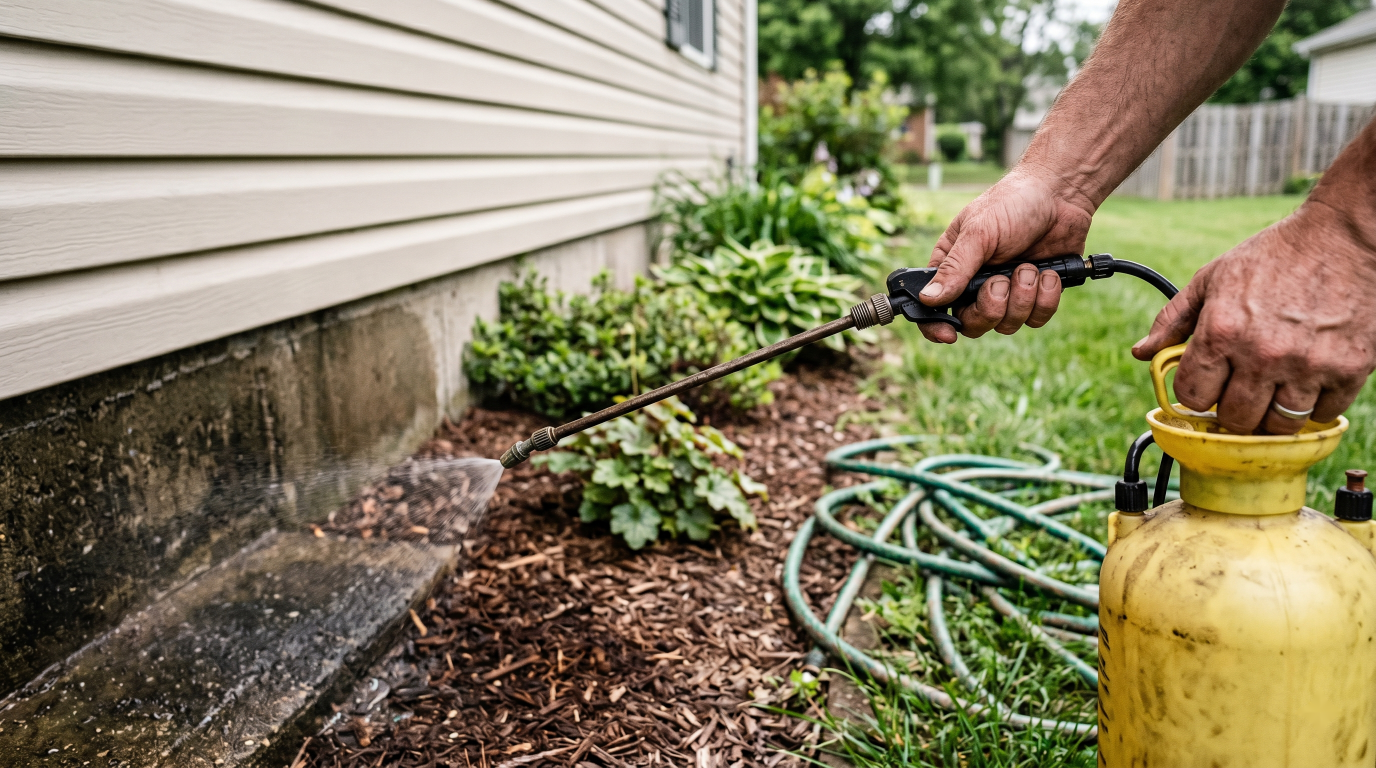
The spraying part — what people call a "barrier treatment" — comes second. You're treating the shady, leafy spots where adult mosquitoes rest during the heat of the day: the underside of leaves on shrubs, dense ground cover, the shaded foundation, under the deck, and along fence lines. You are not trying to fog the open lawn. Mosquitoes don't hang out in sunny open grass; they hide in cool, damp vegetation.
Ants: spray the wrong way and you make it worse
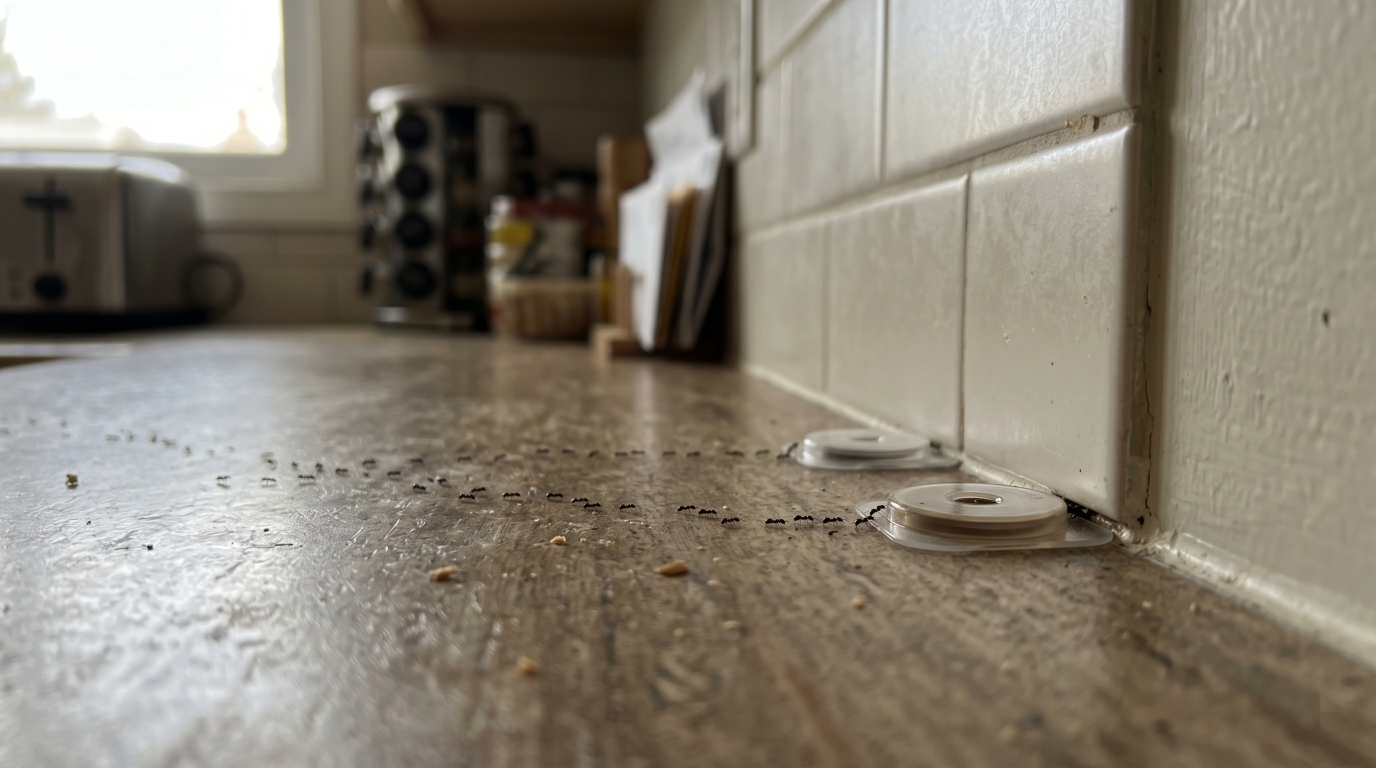
Here's the thing that surprises people. For most ant problems, especially ants coming into the house, a contact spray is the wrong first move. When you spray a trail of ants with a quick-kill product, you kill the few hundred workers you can see — but the colony of tens of thousands stays safe underground, and many species respond by "budding," splitting into multiple new colonies. You can actually multiply your problem.
For ants getting into the house, bait first. Bait stations (the little plastic discs, or gel baits) work because foragers carry the poison back and feed it to the queen and the whole colony. It's slower — you'll see ants for a week or two — but it kills the colony at the source. Liquid ant baits are cheap and very effective for the common sugar ants you see on kitchen counters.
Where the sprayer earns its keep with ants is the perimeter barrier — a treated band around the foundation of your house that stops ants (and a lot of other crawling insects) from getting in to begin with. That's a job for a pump or backpack sprayer with a residual product, and it's exactly what the pros do when they "spray your house."
A quick rule of thumb
Bait kills the colony you can't see. Barrier sprays keep things out and knock down what's resting in the yard. Use both — they do different jobs. Spraying a visible ant trail to "win" today usually costs you next week.
The Three Yard Sprayers for Mosquito Control, and When to Use Each
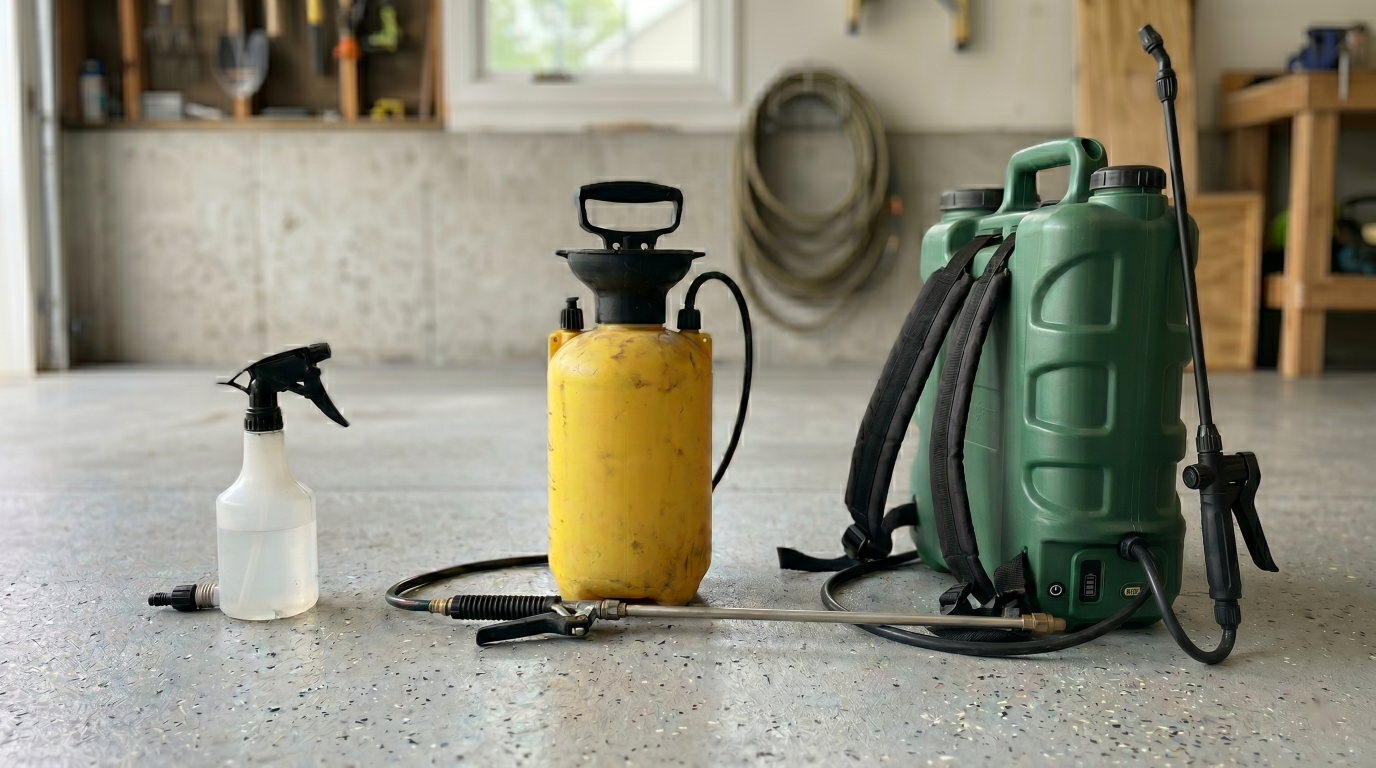
This is the part that confused me for the longest time, because the store shelf has three very different tools that all look like they do the same thing. They don't. Picking the right one is most of the battle.
1. Hose-end sprayers — the easiest entry point
A hose-end sprayer screws onto your garden hose. The water flowing through it automatically siphons and dilutes the concentrate, so you just connect, turn on the spigot, and spray. Many ready-to-use yard products — like Cutter Backyard Bug Control and Ortho BugClear — come in a bottle that is the hose-end sprayer. You attach the bottle, no mixing.
Best for: Broad coverage over a big area fast — treating a whole backyard's worth of shrubs and ground cover for mosquitoes, or covering a large lawn. The reach is good (you get distance from the hose pressure) and there's zero measuring.
The downsides: You're tethered to your hose, so anything past about 30 feet of hose length is out. The dilution is approximate — it depends on your water pressure — so it's less precise than a pump sprayer. And the spray pattern is coarse, which is fine for foliage but not for a tidy line along the foundation.
2. Pump sprayers — the workhorse for most homeowners
A handheld pump sprayer is the one-to-two-gallon tank with a hand pump on top and a wand with a trigger. You mix the concentrate with water in the tank yourself, pump it up to build pressure, and spray. For the average suburban lot, this is the sprayer I'd buy first. A solid one runs $20 to $40 and lasts years.
Best for: Precise perimeter treatments — that controlled band around your foundation for ants, the targeted shrub-by-shrub mosquito work, spot-treating an ant nest, cracks and crevices. You control the exact dilution, so it's the most economical way to use concentrates.
The downsides: A one-gallon tank covers a small-to-medium yard before you're refilling and re-pumping. Your arm gets a workout. Get one with a quality wand and an adjustable nozzle — the $10 bargain models clog and leak. A name-brand one-gallon pump sprayer is worth the few extra dollars.
Dedicate your sprayers
Keep one sprayer permanently labeled for insecticides and a totally separate one for weed killer. Glyphosate residue left in a tank will kill the plants you later spray with insecticide. Write "BUGS ONLY" on it with a paint marker. I learned this after browning a row of hostas I was only trying to protect.
3. Backpack sprayers — for bigger properties
A backpack sprayer is a three-to-four-gallon tank you wear on your back with a wand, and it's the same idea as a pump sprayer — just bigger and far more comfortable for large jobs because the weight rides on your shoulders and hips instead of one arm. When you're shopping, the first fork in the road is how it builds pressure: manual or battery-powered.
Manual (hand-pump): These have a pump lever at your side that you work every so often to keep the tank pressurized as you spray. They're cheaper, lighter, and there's no charging or motor to fail — for most yards a good manual unit is all you need. Look for one with a piston pump, which holds steadier pressure than a cheaper diaphragm pump and gives a more even coat. Solid manual backpacks run about $60–$150; Chapin and Field King are the names you'll see most.
Battery-powered: A small rechargeable pump holds constant pressure for you, so there's no levering at all — you just pull the trigger and walk. That steady pressure makes a noticeably more even application, and it's a back-saver on big jobs. The trade-off is cost and a battery to keep charged. Flow Zone makes dedicated battery backpack sprayers that homeowners and pros both like. If you're already invested in a cordless tool platform, Ryobi (their ONE+ 18V backpack sprayer runs off the same batteries as their drills and trimmers) and DeWalt (20V MAX) both make units that share batteries with the rest of your tools — a real convenience if you've already got the chargers. Expect roughly $130–$300 for a battery backpack sprayer, more if you're buying into the battery for the first time.
Best for: Anything over about a quarter acre, properties with a lot of fence line and tree line to treat for mosquitoes, or anyone who's tired of refilling a one-gallon tank four times.
The downsides: Cost and bulk — overkill for a small townhouse lot. But if you've got real acreage, a backpack sprayer pays for itself in saved time and a much more even coat, and the battery versions in particular take most of the work out of it.
| Sprayer | Best yard size | Mixing | Typical cost | Sweet spot |
|---|---|---|---|---|
| Hose-end | Small–large (within hose reach) | None (auto-dilutes) | $10–$25 | Fast, broad mosquito coverage on foliage |
| Pump (1–2 gal) | Small–medium | You mix it | $20–$40 | Precise foundation perimeter & spot treatments |
| Backpack (3–4 gal) | Large / acreage | You mix it | $60–$150 manual / $130–$300 battery | Big properties, long fence/tree lines |
The Best Mosquito Spray for Your Yard: Decoding the Store Shelf
Walk into any hardware store and the pest aisle is a wall of brightly colored bottles all promising to "kill 100+ insects." It's overwhelming, but it gets simple once you realize most of them rely on the same handful of active ingredients — a class of synthetic insecticides called pyrethroids. The brand on the front matters less than the active ingredient on the back label. Here's what's actually in the common ones.
Spectracide
Spectracide Triazicide is the budget-friendly staple, and it works. The active ingredient is gamma-cyhalothrin, a pyrethroid. It comes as a concentrate (for your pump or backpack sprayer) and as a ready-to-spray hose-end bottle. It's marketed heavily for lawn-dwelling and soil insects (grubs, ants, fleas, ticks, chinch bugs) and it's a fine general-purpose yard insecticide. For the money, it's hard to beat.
Ortho
Ortho splits its lineup, which trips people up:
- Ortho Home Defense is the perimeter product — the one in the jug with the battery-powered wand, designed for that barrier band around your foundation and along baseboards indoors. Active ingredient: bifenthrin. This is the ant-barrier go-to.
- Ortho BugClear for Lawns & Landscapes is the yard product, sold as a hose-end and as a concentrate. It uses bifenthrin plus zeta-cypermethrin and is aimed at broad outdoor coverage — the mosquito-and-everything-else barrier spray.
What the active ingredient tells you
Pyrethroids (bifenthrin, lambda/gamma-cyhalothrin, cypermethrin, permethrin) are residual contact insecticides. That means they keep working for a few weeks after they dry — an insect that walks across the treated surface picks up a lethal dose. That residual quality is exactly why a barrier treatment keeps ants out for weeks, and why a single mosquito barrier spray lasts about three to four weeks before you need to reapply.
For a basic, effective home arsenal, you really only need three things: a bait for ant colonies, a residual concentrate (Triazicide or a bifenthrin product) for your sprayer, and Bti dunks for any standing water you can't drain. That covers 90% of suburban bug problems.
The label is the law — literally
Every pesticide label is a legal document. The directions for mixing rate, where you may apply it, and how long to keep people and pets away are requirements, not suggestions. "If a little works, more works better" is false and illegal — over-applying doesn't kill more bugs, it just puts more poison in your soil and water and risks harming pets and pollinators. Read the whole label before you open the bottle.
How to Spray Your Yard for Mosquitoes Safely (Pets, Kids, Bees)
This is the part the YouTube videos rush through, and it's the part that actually matters. None of this is hard — it's just a short checklist you run every time.
Protect yourself first
Before you mix anything, put on the basics:
- Chemical-resistant gloves — nitrile gloves, not cloth or leather, which soak it up and hold it against your skin.
- Eye protection — safety glasses or goggles. Concentrate splashing back while you pour is the most common way people get exposed.
- Long sleeves, long pants, and closed shoes. Skin coverage is your main protection. Save the spraying for when it's cool out so long sleeves aren't miserable.
- For backpack work or anything you're spraying overhead, add an N95 mask so you're not breathing the drift.

Mix smart
- Measure the concentrate with a dedicated measuring cup you never use for food. Follow the label rate exactly.
- Add water to the tank first, then the concentrate, then top off. This reduces foaming and splash-back.
- Mix outdoors or in a well-ventilated spot, over a surface you don't mind getting a drip on — not the kitchen counter.
- Mix only what you'll use that day. Diluted product doesn't store well, and you shouldn't keep a sprayer full of mixed insecticide sitting in the garage.
Apply at the right time and place
- Spray in the early morning or evening, when it's calm and cool. Wind causes drift onto places (and people) you don't want treated.
- Never spray blooming flowers. Pyrethroids are highly toxic to bees. Treat foliage and structure, avoid anything in bloom, and you spare the pollinators. Spraying at dusk also helps, since bees aren't foraging then.
- Check the forecast. Don't apply if rain is expected within 24 hours (or whatever the label says) — it washes the product off before it can dry and bind, wasting it and sending it into storm drains.
- Keep it away from water. Pyrethroids are extremely toxic to fish and aquatic life. Don't spray near ponds, streams, storm drains, or ditches.
- Keep kids and pets off treated areas until everything is completely dry — usually a few hours. The label gives the specific re-entry time. Dry means safe to walk on; wet means stay off.
Two hard "don'ts"
Don't treat your vegetable garden or fruit with a general yard insecticide unless that specific crop is named on the label with a stated days-to-harvest interval. And never spray near a beehive or a visibly active patch of clover or flowering weeds full of bees. If you must treat an area in bloom, mow off the flowers first and wait a day.
Store and clean up properly
- Rinse your sprayer and spray the rinse water onto an already-treated area (not down the drain).
- Store concentrates in their original labeled containers, up high, locked away from kids and pets, and away from food and from freezing.
- Wash your hands and forearms when you're done, and throw your clothes straight in the wash — separate from the family laundry.
- Never pour leftover product down a sink, toilet, or storm drain. Use it up at label rate or take it to a household hazardous-waste collection.
A Season-Long DIY Mosquito Control Plan for Your Yard
Here's how I actually run it, and it keeps mosquitoes and ants from ever getting a real foothold without me thinking about it much.
Early spring (before they show up): Walk the property and eliminate standing water. Drop Bti dunks in the rain barrel and any low spots that hold water. Put out ant bait stations along the foundation and anywhere I saw trails last year — getting ahead of the colonies before they're big is far easier than fighting them in July.
Late spring / early summer: First barrier treatment. With the pump sprayer, I lay down a band along the foundation, around door and window frames, and a couple feet up and out — that's the ant and crawling-insect barrier. Then I switch to the hose-end (or backpack on a bigger yard) and treat the shady mosquito-resting zones: under the deck, dense shrubs, the shaded fence line and tree line.
Through summer: Reapply the mosquito barrier every three to four weeks, or after heavy rain. Refresh ant bait when the stations empty. Keep dumping standing water after every big rain — that's the free, no-chemical step that does the heavy lifting.
Anytime ants get inside: Resist the urge to spray the trail. Set bait right where they're entering, be patient for a week or two, and re-treat the exterior perimeter if the barrier has worn off.
When to Call a Mosquito or Pest Service Instead
DIY handles the vast majority of mosquito and ant problems, but a few situations are worth a professional. Carpenter ants (the big black ones) or any ants associated with damp, damaged wood can signal a moisture or structural problem — and they nest inside the structure, where surface sprays won't reach. Fire ants, if you're in their range, have specific mound-treatment protocols. And anything pointing to termites (mud tubes on the foundation, swarmers indoors) is not a DIY job — that's a call to a licensed company, today, because the cost of waiting is structural.
For everyday summer mosquitoes and the ants marching across your patio, though? You've got this. The right sprayer, the right product at the labeled rate, a little protective gear, and a habit of dumping standing water will get you a yard you can actually enjoy at dusk — without paying someone $100 a month to do what takes you twenty minutes.
DIY Mosquito Control: Common Questions
How do I get rid of mosquitoes in my yard without a service?
Three steps. Dump every bit of standing water weekly; mosquitoes breed in as little as a bottle cap of water and stay within a couple hundred feet of where they hatch. Put Bti dunks in water you can’t drain. Then spray a residual pyrethroid like Spectracide Triazicide or Ortho BugClear on the shady vegetation where adults rest, and reapply every three to four weeks. That is the same approach the services use, for a few dollars an application.
How often should I spray my yard for mosquitoes?
Every three to four weeks during the season, or sooner after heavy rain washes the product off. Residual pyrethroids keep killing for a few weeks after they dry; when the bites come back, it’s time. Standing water needs checking after every big rain regardless.
What is the best time of day to spray for mosquitoes?
Early morning or evening, when the air is calm and cool. Dusk is ideal: mosquitoes are becoming active, bees have stopped foraging, and there is little wind to carry drift. Don’t spray if rain is expected within 24 hours.
Is DIY mosquito yard spray safe for pets and kids?
Yes, when it’s used exactly as the label says. Keep everyone off treated areas until the spray is completely dry, usually a few hours; the label lists the exact re-entry time. Store concentrate locked up, and never treat a vegetable garden with a general yard insecticide unless that crop is named on the label.
Will mosquito spray kill bees?
It can. Pyrethroids are highly toxic to bees, so never spray anything in bloom, including flowering weeds and clover. Treat foliage and structure only, spray at dusk when bees aren’t out, and you avoid nearly all of the risk.
Can I use the same spray for mosquitoes and ants?
Mostly, yes. Bifenthrin and gamma-cyhalothrin products handle both as a barrier spray. The difference is where you put it: the foundation perimeter for ants, shady vegetation for mosquitoes. For ants that are already inside, use bait instead of spray so the foragers carry it back to the colony.
Do mosquito dunks actually work?
Yes, for the water they’re in. Bti is a bacteria that kills mosquito larvae and is harmless to people, pets, fish, and birds. One dunk treats about 100 square feet of water surface for around 30 days. Dunks do nothing for adults already flying, which is what the barrier spray is for.
Heads up: some of the product links above are Amazon affiliate links. If you buy through them it doesn't cost you anything extra, and it helps keep these guides coming. I only link to products I'd actually use in my own yard.