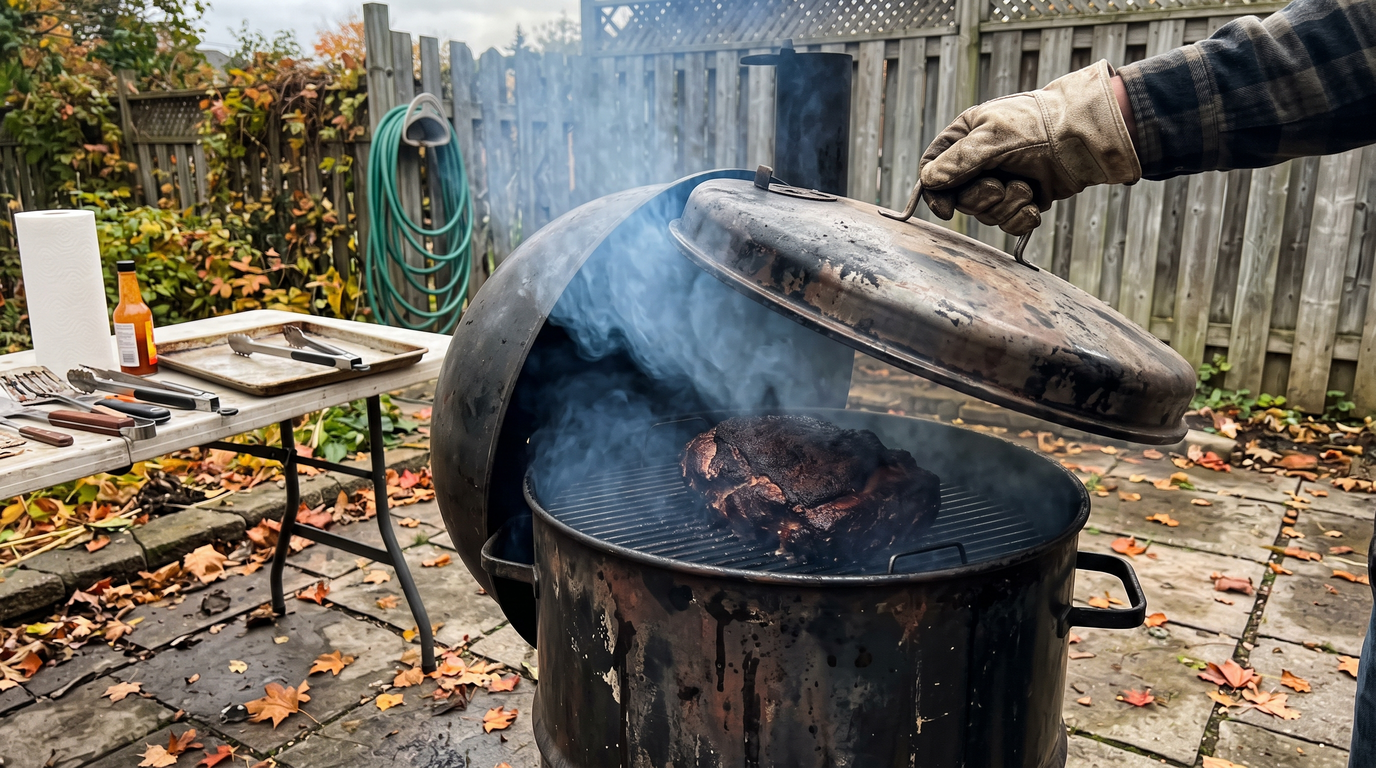
Summer is grilling season. Fall is smoking season. The air cools off, football takes over the weekends, and somewhere around the first cold Saturday a lot of people decide this is the year they learn to make real barbecue. Then the holiday catalogs show up, and a smoker starts looking like the perfect gift, for somebody else or for yourself.
Here's the catch. A smoker is a bigger commitment than a grill. A grill cooks dinner in twenty minutes. A smoker asks for a whole day, a bag of fuel, and some patience, and it rewards you for that in a way nothing else does. Buy the wrong one and it'll sit under a cover in the corner of the patio, looking at you.
So, like our gas vs. charcoal vs. pellet grill comparison, this guide is built around how you actually cook, not which smoker a barbecue purist would defend. Five types, what each is genuinely good at, where each one disappoints, what it costs to feed for five years, and the handful of build details that separate a smoker that lasts from one that rusts.
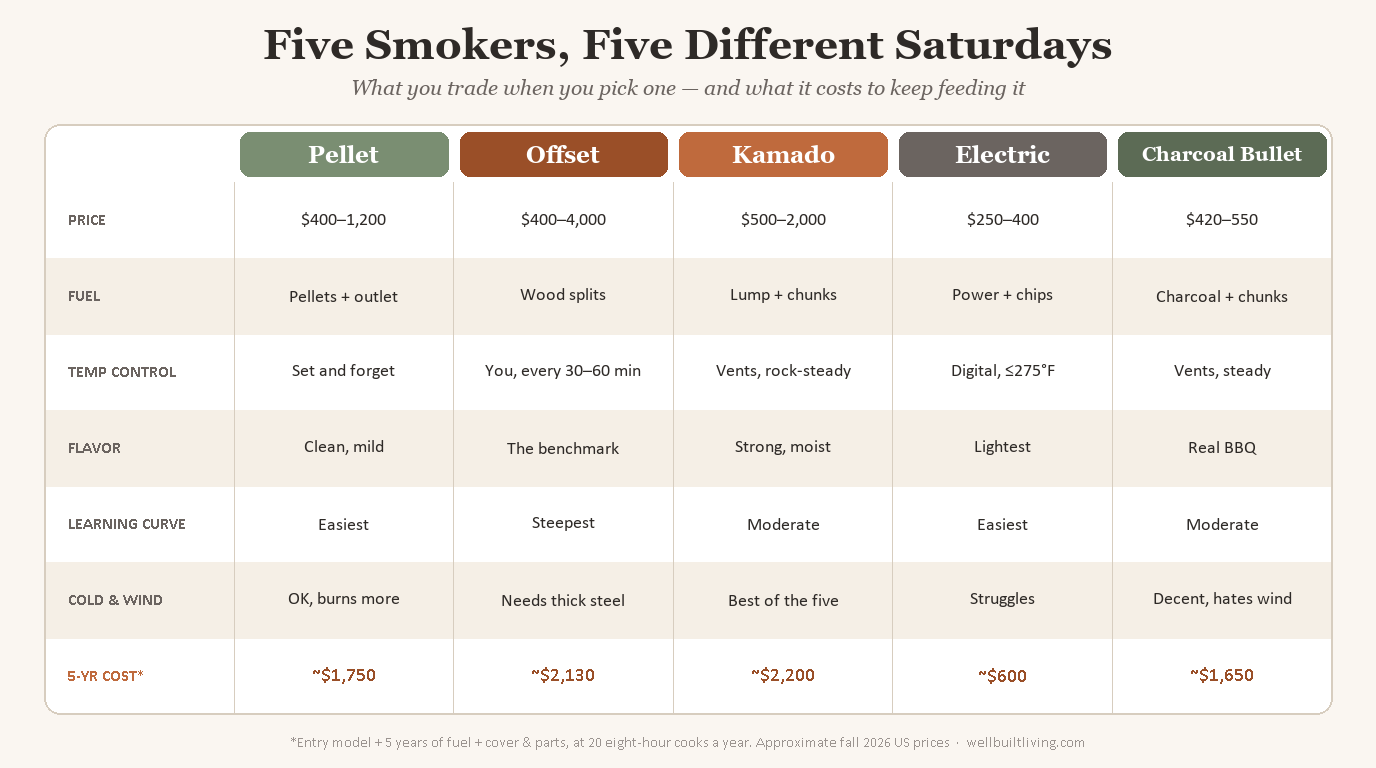
The five smokers, side by side
Prices below are typical list prices from the major brands as of fall 2026. Sales, especially around Black Friday, can knock a real chunk off, but the tiers hold.
Pellet: barbecue for people with other plans
A pellet smoker is a thermostat with a fire attached. An auger feeds hardwood pellets into a small burn pot, a fan feeds it air, and a controller keeps the temperature wherever you set it. Put a pork shoulder on at 250°F, go rake leaves, come back in eight hours. That's the whole pitch, and it's a good one. It's why pellet grills took over the middle of the market.
The honest trade is flavor intensity. Pellets burn clean and efficiently, which is exactly why the smoke is milder than what comes off a stick burner. It's real wood smoke and plenty of people prefer it, but if you've eaten brisket from a Texas offset and that's the target, a pellet smoker gets you most of the way, not all of it. And it's an appliance: it needs an outlet, it has a controller and an igniter that will eventually need replacing, and damp pellets swell up and jam the auger.
Price-wise, Pit Boss lives mostly in the $500 to $1,000 range, Traeger starts around $550 for the Pro 22 and climbs past $3,000 for the top Timberline models, and Camp Chef's Woodwind line sits around $1,000 to $1,300 before sales. The good news for gift shoppers: pellet grills go on sale regularly around Black Friday, so it pays to watch prices through November.
Offset: the real thing, and a real hobby
An offset is the classic barbecue shape: a long cooking chamber with a firebox bolted or welded to one end. You burn real wood in the box, and the heat and smoke pull across the meat and out the stack. Nothing else makes flavor like it. This is the smoker the famous barbecue joints use, scaled down.
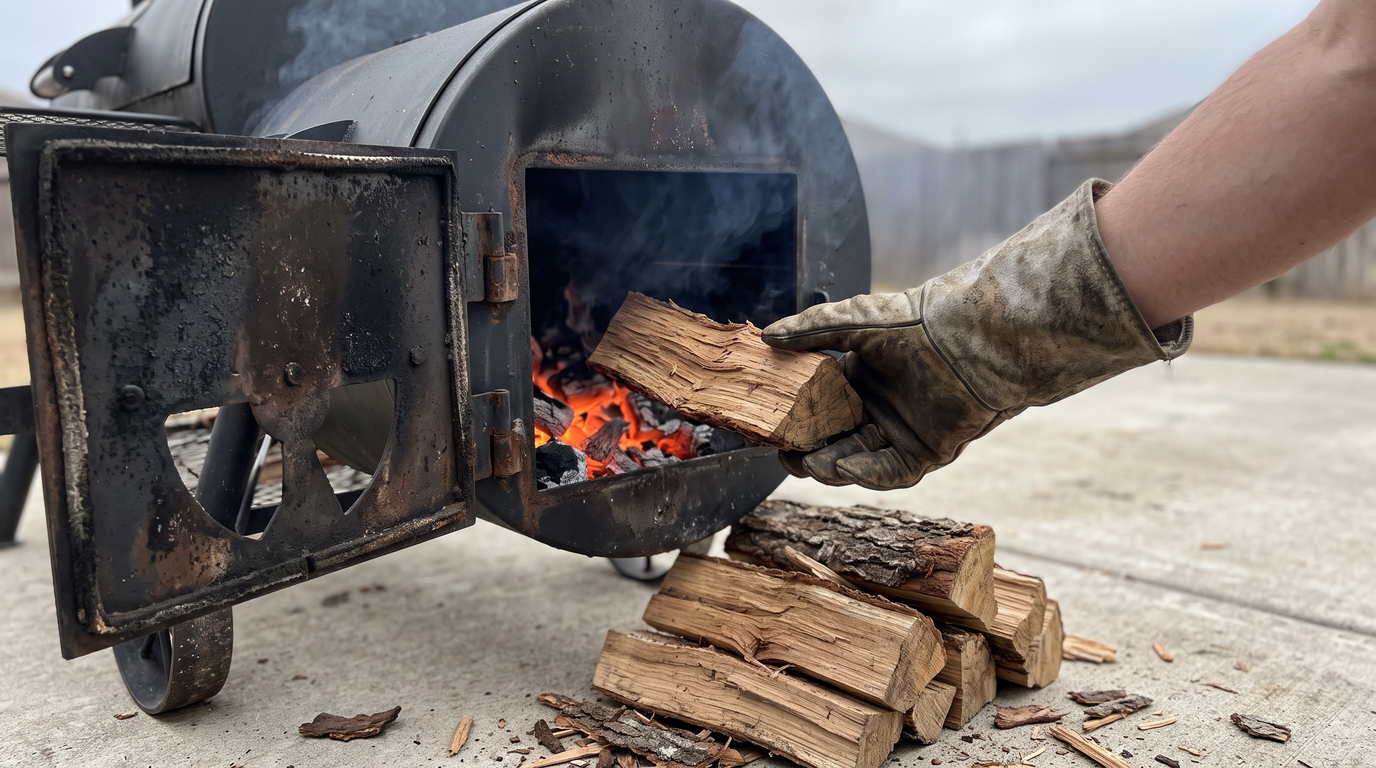
The price of that flavor is attention. You're managing a live fire for the whole cook, adding a split every 30 to 60 minutes and adjusting the vents to keep a clean, small fire instead of a smoldering one. That's either the best part of your Saturday or a twelve-hour chore, and only you know which.
The bigger trap is steel. A classic entry offset like the Oklahoma Joe's Highland costs about $430 and uses thin sheet steel, which means heat leaks out the seams and the temperature swings with every gust of wind. It's a fine way to learn, and plenty of people seal the gaps with a gasket kit and make great food on one. But the offsets that hold heat effortlessly are welded from quarter-inch steel, and they start around $1,500 and run past $3,500 from custom builders. There's very little in between that's worth the jump. Either buy cheap to find out if you like it, or save up for the real thing.
Kamado: the one that doesn't care about the weather
If you read the grill comparison, you know the kamado already: the egg-shaped ceramic cooker that does 700°F steaks and 225°F brisket equally well. As a smoker, its superpower is insulation. Thick ceramic walls hold heat so well that a kamado will sit at 225°F for twelve-plus hours on a single load of lump charcoal, even when it's 30 degrees and windy. It's the most fuel-efficient smoker on this list, and the meat tends to come out moist because so little air moves through it.
The downsides: capacity and cost. An 18-inch kamado cooks one brisket or two pork shoulders, not a crowd. A Big Green Egg Large starts around $1,200 for the egg alone, with the nest or table extra. Kamado Joe's Classic line runs from about $850 to around $1,800 depending on generation and cart. Budget kamados start closer to $500, usually with thinner walls and shorter warranties. And once you overshoot your temperature, a kamado takes a long time to come back down. You learn to sneak up on your target instead of charging past it.
Electric: easiest start, lightest smoke
An electric smoker is an insulated box with a heating element and a tray for wood chips. Masterbuilt's 30-inch digital models run $250 to $300, and the 40-inch models are about $350 to $400. You plug it in, set the temperature, add chips every so often, and it holds steady. For someone who wants smoked salmon, jerky, or ribs without learning fire management, it's a genuinely good tool and by far the cheapest to run.
The honest limits: smoke flavor is the lightest of the bunch, you'll rarely see much of a smoke ring (that pink band comes mostly from gases produced by burning fuel, and there's very little combustion in an electric box), and many top out around 275°F, which makes crisp poultry skin tough. They're also appliances with an element and a controller, and those are the parts that fail. Warranties are short: Masterbuilt's is one year.
The budget sleeper: the charcoal bullet
The vertical charcoal smoker, best known as the Weber Smokey Mountain, deserves more attention than it gets. Charcoal ring on the bottom, water pan in the middle, two grates up top. Light it with a partial chimney on top of unlit charcoal and wood chunks, and it'll hold 225 to 250°F for eight hours or more with nothing but small vent tweaks. The 18-inch model is about $420 and the 22-inch is about $550, and Weber warranties the bowl, lid, and center section for ten years against rust-through and burn-through.
You get real charcoal-and-wood barbecue, closer to an offset than a pellet grill, for a fraction of what a good offset costs, and you don't have to feed it every 45 minutes. If you want to find out whether you actually like smoking meat before spending $1,500, this is the smart money.
What five years of smoking actually costs
Same exercise as the grill comparison: the price tag is only the entry fee. Here's the math, with every assumption on the table so you can swap in your own.
Assumptions: twenty long cooks a year, about eight hours each. Pellets at about $1 a pound (a 20-pound bag runs about $20) and roughly 1.25 pounds an hour at smoking temperatures. Briquettes at about $1.25 a pound, lump at about $1.50. Cooking wood for the offset bought by the face cord at around $0.40 a pound. Electricity at about 17 cents per kilowatt-hour, with an 800-watt element cycling about half the time. Upkeep covers a cover plus the parts each type tends to wear out: igniters and fans on pellet grills, gaskets on kamados and offsets, elements and controllers on electrics. Purchase prices use a typical entry model in each category.
Two things jump out. First, the entry offset, the second-cheapest smoker to buy, is the second-most expensive to own, because burning real wood for eight hours eats a lot of real wood. (If you've got a free wood source, cross most of that fuel line out.) Second, the kamado's big sticker price is partly paid back by fuel efficiency; it spends less on charcoal per cook than anything but the electric. And the electric is in a league of its own on cost. That's not an argument for electric so much as proof that you're paying for flavor with fuel.
These are estimates, not promises. Cook in the cold, cook longer, or cook more often and every fuel number goes up. But the shape holds, and it's worth knowing before you decide the cheap one is the budget option.
Which smoker fits how you cook
Forget which one wins the taste test. Picture a real Saturday in November and pick the one you'll actually use on it.
- You want barbecue, but you also want to run errands, watch the game, and not think about a fire: pellet. It's the shortest path from wanting ribs to eating ribs, and the most forgiving smoker to learn on.
- Tending the fire is the point, and you'd happily spend a whole Saturday on it: offset. Buy an entry model with a gasket kit to learn, or save for a thick-steel pit if you already know you're hooked. Skip the middle.
- You want one cooker that smokes, sears, and bakes pizza, all year, in any weather: kamado. Just make sure it has a permanent home. It's heavy and it isn't moving.
- You want smoked salmon, jerky, and the occasional rack of ribs with the least fuss and cost: electric. Keep it under cover and accept a lighter smoke flavor.
- You want real charcoal barbecue without spending much, and you're not sure how serious you'll get: a charcoal bullet. It's the best value on this list.
- You already own a kettle and you're not sure you'll smoke more than a few times a year: don't buy anything yet. Read the next section.
And if you're still deciding whether you need a dedicated smoker or a grill that can do a bit of both, our grill picker asks six questions about how you actually cook and points you at the right type.
Your kettle can already smoke (seriously)
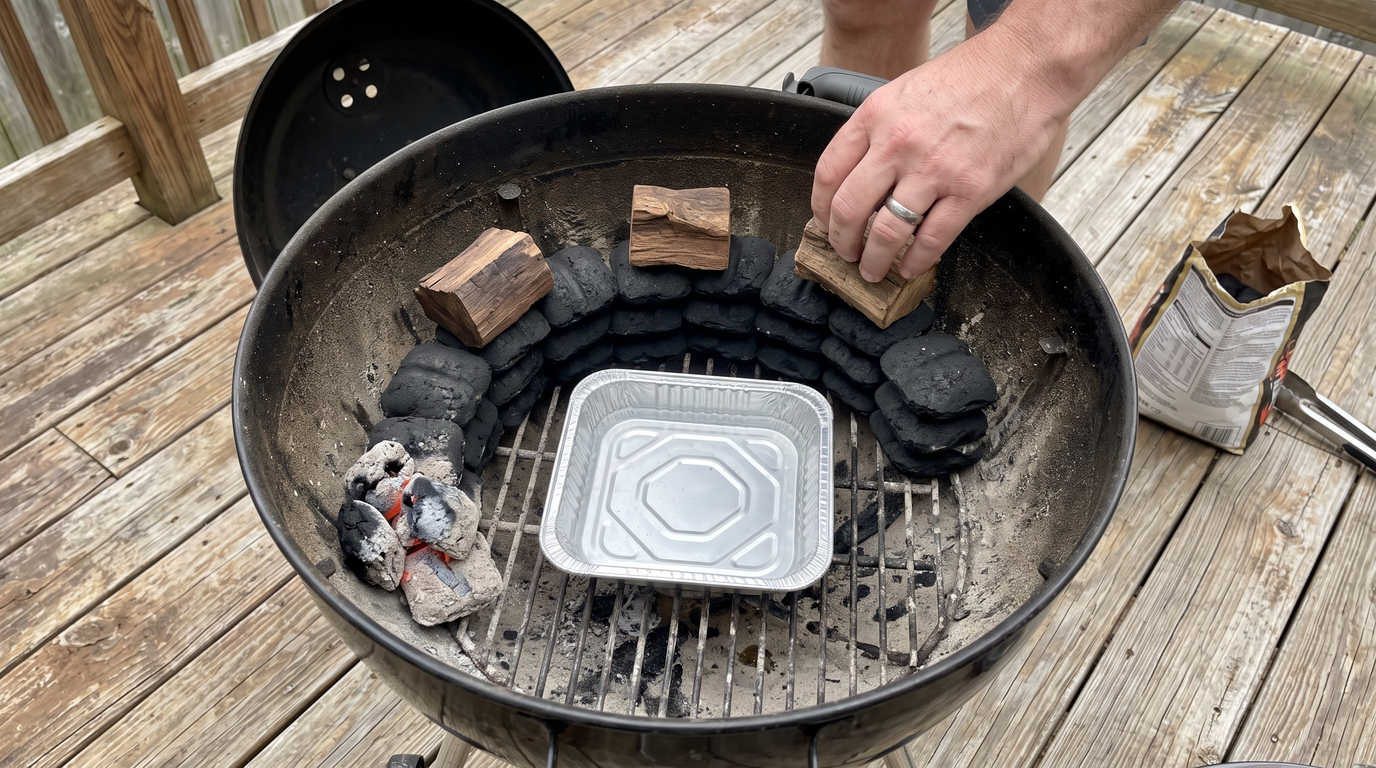
Nobody selling smokers wants to mention this, so here it is: a basic 22-inch charcoal kettle, the $150 to $220 grill half the neighborhood already owns, makes legitimately good barbecue. The trick is called the snake method. Arrange briquettes in a C-shape around one side of the bowl, two rows wide and two high, set a few wood chunks along the top, and light just one end. The fire burns slowly along the snake like a fuse, and with the vents mostly closed it'll hold around 225 to 275°F for six to eight hours. Put a pan of water in the middle of the C, the meat over the pan on the other side, and close the lid.
It isn't as roomy as a real smoker, a full brisket is a tight fit, and you'll check it more often. But a few pork shoulders on a kettle will tell you for free whether you love this enough to spend $600 or $1,600 on it. That's the cheapest research you'll ever do.
What to check before you buy
Smoker spec sheets are full of noise. These are the details that actually decide whether it holds temperature and lasts.
- Steel thickness (offsets and cabinet smokers). Thicker steel holds heat and evens out temperature swings, and this matters more than any feature. Budget offsets use thin sheet steel and often don't publish the thickness at all; that silence tells you something. Quarter-inch steel is the serious tier. If a seller lists a gauge, remember the numbers run backward: 10-gauge is thicker than 14-gauge.
- Gaskets and seals. Close the lid or door on a dollar bill and pull. If it slides out easily, heat and smoke are leaking there. Smoke pouring out the seams of a cheap offset is common; a high-temperature gasket kit is a $20 fix. On a kamado, check that the felt gasket is fully bonded all the way around, because it's the first part to wear.
- Controller and Wi-Fi (pellet and electric). Look for a stated temperature swing near ±15°F rather than vague "precision" language. Wi-Fi is genuinely handy on a twelve-hour cook, letting you check the pit and the meat from the couch, but it's the feature most likely to be flaky, and the smoker still has to work without it. Make sure it does.
- Hopper size (pellet). Match it to your longest cook. At smoking temperatures most pellet grills burn roughly one to one-and-a-half pounds an hour, so an 18-pound hopper like the Traeger Pro 22's covers about twelve to eighteen hours before a refill, more than enough for a brisket. Cold weather burns faster. A pellet dump chute makes switching wood flavors far less annoying.
- Warranty. This is a straight read on how long the maker expects it to last. Current Traegers carry seven to ten years depending on the model, Pit Boss pellet grills five, Weber gives ten years on the Smokey Mountain's main body against rust-through, and Big Green Egg has a limited lifetime warranty on the ceramics. The Oklahoma Joe's Highland carries two years, and Masterbuilt electrics one. Read what's covered: paint and rust are almost always excluded.
- Primary cooking area. Same rule as grills: ignore "total" numbers that count every rack, and compare the main grate. A full packer brisket needs about 18 inches of clear length, so measure before you assume it fits.
Don't trust the lid thermometer
The dial thermometer built into most smoker lids reads the air near the top of the dome, several inches above your meat, and cheap ones can be badly off. Budget for a dual-probe wireless thermometer, one probe at grate level and one in the meat, no matter which smoker you buy. It's the single most useful accessory in barbecue.
If it's a gift
A smoker makes a great gift for the right person and a guilt-inducing lawn ornament for the wrong one. Before buying, find out three things quietly: where it'll live (is there an outlet within reach, and is it going on a wooden deck?), how they cook now (a weekend-project person or a weeknight-dinner person?), and whether they'd rather tend a fire or watch the game. Then use the section above.
Give yourself runway
Smokers ship as big, heavy freight boxes and take an afternoon to assemble, and a kamado can weigh close to 200 pounds. Order by early December, and consider assembling it before the big day, so it's standing there ready to go instead of sitting in a box in the garage until spring. Add a heavy-duty cover and a thermometer and the gift is actually complete.
Mistakes that turn a smoker into patio furniture
- Buying for the fantasy instead of the calendar. An offset for someone who has four free Saturdays a year is a very expensive planter. Be honest about your weekends.
- Buying the cheapest offset and expecting Texas. Thin steel can make great food, but it takes sealing, practice, and babysitting. If you want the flavor without the fuss, the $420 charcoal bullet is the better budget buy.
- Buying too big. A huge smoker burns more fuel heating empty space on every cook. Size it for the cook you do most, not the party you throw once a year.
- Skipping the burn-in. Almost every manual calls for a first run at high heat, empty, to burn off manufacturing oils and cure the paint. Skip it and your first brisket tastes faintly like a machine shop.
- Opening the lid to check. Every peek dumps heat and adds cooking time. That's what the wireless thermometer is for.
- Panicking at the stall. Big cuts like brisket and pork shoulder often sit at the same internal temperature for hours partway through. It's normal. Don't crank the heat; wait it out or wrap it.
- Leaving pellets in the hopper for the winter. Pellets soak up humidity and turn to sawdust, which then sets like concrete around the auger. Empty the hopper between long gaps and store pellets in a sealed bin.
- Parking it anywhere. Keep smokers well away from siding and overhangs, and put a heat-resistant mat under anything sitting on a wooden deck. Embers and grease drips aren't kind to a finish you spent two weekends putting on.
Whatever you buy, this is what keeps it going
Smokers die the same way grills do: grease, moisture, and neglect. Scrape the grates and empty the grease and ash after every cook, since wet ash holds moisture against steel and that's how fireboxes rust out. Keep it covered between cooks. Once a season, check the gaskets and wipe any surface rust and touch it up with high-heat paint. The same grease-and-drip-tray routine in our gas grill cleaning guide applies almost word for word. And if the smoker is the start of a bigger backyard plan, our outdoor living upgrades guide has ideas for building the rest of the patio around it.
The smoker worth buying is the one that matches the Saturdays you really have. Be honest about that and any of these five will make you the most popular person on the block by Thanksgiving. Be aspirational about it and you'll own something excellent that you resent every time the forecast says 38 and windy. If you're not sure yet, light a snake of charcoal in your kettle this weekend. The pork shoulder will tell you what to buy.