Most vegetable gardens get planted exactly once. Everything goes in over a weekend in May, produces heavily in July, and by the first week of September the beds are a tangle of exhausted tomato vines and one zucchini the size of a forearm that nobody wants to talk about.
Meanwhile the best growing weather of the year is about to arrive. Lettuce that bolts and turns bitter in July is sweet and slow in October. Carrots and kale actually improve after a frost. The bugs that shredded your brassicas in June are dying off. Fall is the easier season — and the reason most people miss it is that the window to start it opens while it's still ninety degrees out and planting seeds feels absurd.
That's the whole problem in one sentence. Fall planting is a July and August job, and it runs on arithmetic rather than on how the weather feels. Here's the arithmetic.
The one calculation that decides everything
Spring planting counts forward from your last frost. Fall planting counts backward from your first one, and it needs three numbers rather than one.
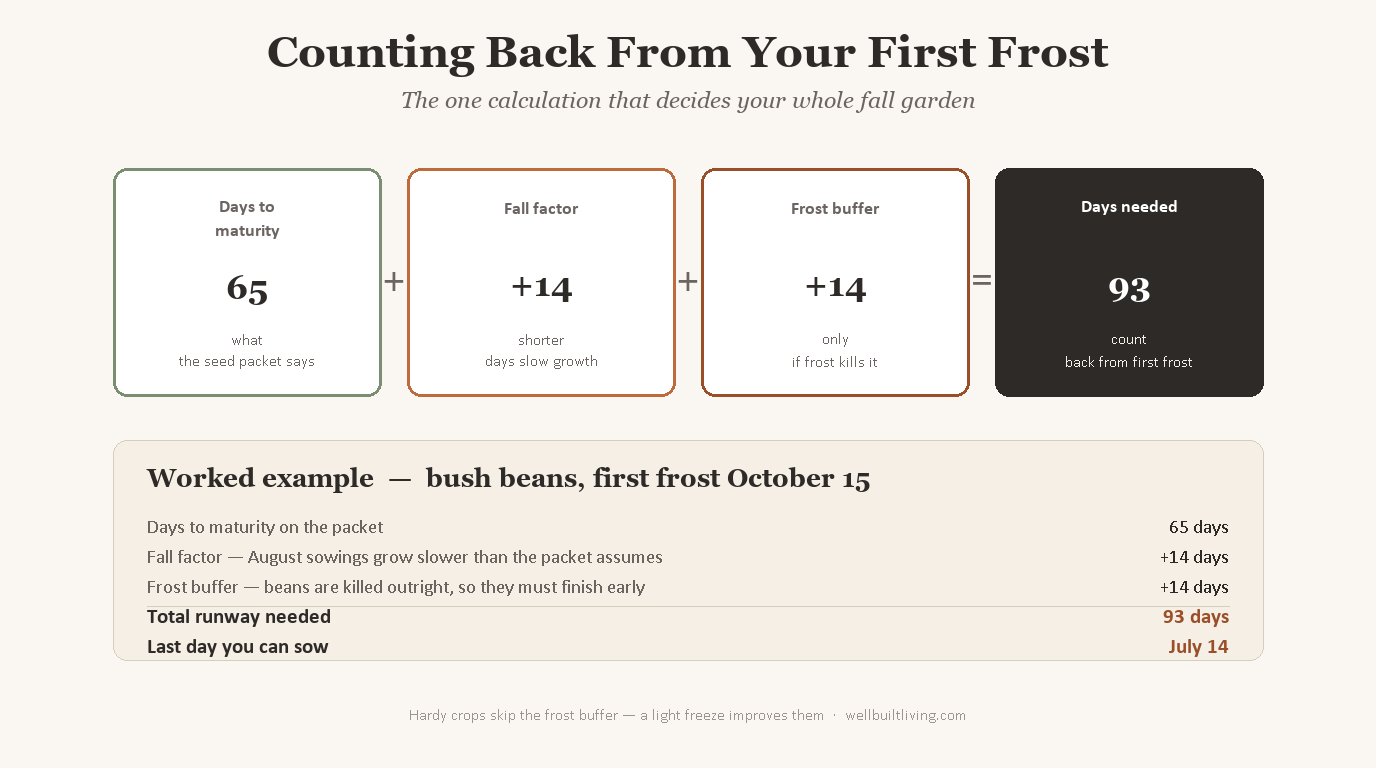
Days to maturity is on the seed packet. Use the slow end of the range if it gives one — in fall you don't get to be optimistic.
The fall factor is about two weeks. A crop the packet calls 50 days genuinely takes closer to 64 when it's sown in August, because it spends its life in shortening days and cooling soil rather than lengthening days and warming soil. Every extension service builds this fudge factor in; skipping it is the single most common way fall plantings fail.
The frost buffer is another two weeks, and it applies only to crops that frost kills outright — beans, cucumbers, squash, corn, basil. Those have to be finished and harvested before frost arrives, not merely alive when it does. Hardy crops skip this entirely.
Add them, count back from your average first frost, and you have the last honest day to put that seed in the ground.
Skip the arithmetic
Our planting calendar by ZIP code runs this for every crop at once. Enter your ZIP, and it pulls your first frost date from NOAA climate normals and gives you the last safe sowing date for each vegetable — plus what's worth starting this week. It's the same formula, done thirty-eight times.
First, find your actual frost date
Every number in this article is worthless without a real first-frost date for your specific area, and "zone 6" is not that. USDA hardiness zones describe average winter lows — they tell you whether a shrub survives January, not when your tomatoes die. Two places in the same zone can have first frosts three weeks apart.
What you want is the NOAA climate normal for your location: the date with a 50% probability of a 32°F freeze. Look it up once, write it on the inside of the shed door, and use it for the rest of your gardening life. Ours is built into the calendar tool for every ZIP code in the country.
What 50% actually means
A 50% probability date means frost arrives later in half of all years — and earlier in the other half. It's a planning midpoint, not a deadline. If a planting is precious, give it an extra week of margin, or keep a row cover within reach.
What's still worth planting
Count the weeks between today and your first frost, then read across.
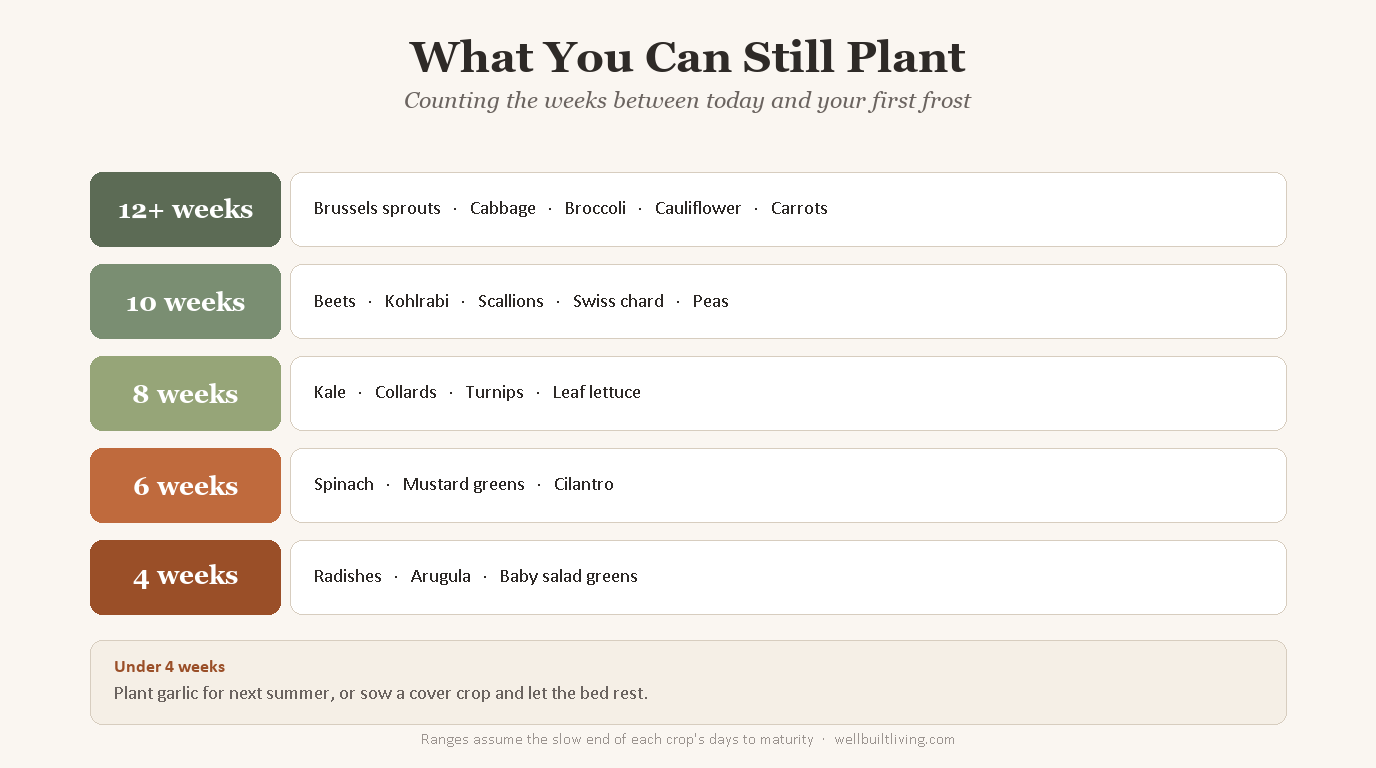
Days to maturity and cold tolerance above follow the University of Minnesota Extension's guide to midsummer planting for fall harvest. Varieties differ, sometimes by three weeks, so the packet in your hand always wins.
The part nobody warns you about: germinating in August
Fall sowing has one genuine difficulty, and it isn't the cold. It's that you're asking cool-season seed to germinate in hot soil. Lettuce and spinach go dormant above roughly 80°F — the seed simply refuses, and gardeners conclude they got a bad packet.
- Sow deeper than you would in spring. A half-inch down is cooler and holds moisture far better than a quarter-inch
- Shade the bed for the first week. A board laid over the row, a scrap of shade cloth, or even a wet burlap sack — check daily and pull it the moment seedlings show
- Water lightly twice a day until germination. Hot soil dries at the surface in hours, and a seed that swells and then dries out is dead
- Start brassicas in a flat somewhere shaded and transplant at three weeks. Broccoli, cabbage and cauliflower germinate far more reliably out of the sun
- Pre-sprout stubborn seed — spinach and lettuce between damp paper towels in the fridge for a few days, then sow the ones that have chitted
The one worth doing
If you only adopt one of these, make it the board over the row. It costs nothing, and the difference in a spinach or lettuce stand sown in August is the difference between a crop and an empty bed.
Garlic is the exception that ignores all of this
Garlic is the one crop where the frost math doesn't apply, because you're not trying to harvest before winter — you're trying to establish roots and then let it sit. Plant cloves three to six weeks before your first hard freeze, mulch them heavily, and forget about them until spring. Harvest comes the following July.
It's also the best possible use of a bed you'd otherwise leave empty, and it's genuinely difficult to get wrong. If you're reading this too late for anything else, plant garlic.
Stretching the season past your frost date
Your first frost is rarely the end. It's usually one cold night followed by two or three more weeks of perfectly good growing weather, which is why a little protection pays so well in fall.
- Floating row cover buys about 2–4°F and takes sixty seconds to throw over a bed. The cheapest season extension there is
- A low tunnel — hoops plus cover — buys closer to 6–8°F and stands up to wind and the weight of wet snow
- Mulch over root crops. Carrots, parsnips and leeks keep in the ground under a deep straw blanket well past the point the tops die back
- Cold frames against a south-facing wall will carry spinach and mâche through most of the winter in a surprising number of climates
None of that changes the arithmetic — a crop still needs its days to maturity before growth effectively stops in late autumn. What protection buys you is insurance against the one early freeze that arrives three weeks before the normal date.
Where fall gardens go wrong
- Planting too late because August felt too hot to think about it. This is the big one, and it's why the calculation matters more than the instinct
- Using the packet's days to maturity as-is and losing the crop by two weeks. Add the fall factor
- Planting warm-season crops for fall. A tomato sown in August will not fruit before frost anywhere with a real winter
- Forgetting the bed is already occupied. Fall crops need somewhere to go — pull the spent beans and squash rather than waiting for them to die politely
- Skipping fertility. The spring crop already stripped that soil. A few inches of compost before the second planting is not optional
- Watering like it's October when it's still August. Newly sown fall beds need the same attention as spring ones for the first three weeks
Start with the date, not the seed rack
The fall garden rewards planning in a way the spring one doesn't. In May, planting a week late costs you very little. In August, a week late is the whole crop — the frost doesn't negotiate.
So work backward. Get your frost date, subtract the days each crop needs, and you'll know exactly which of them are still live options and which have already closed for the year. Our planting calendar does it for your ZIP in a couple of seconds, including the succession sowings that keep salad coming rather than arriving all at once. Then go plant the ones that are still open — and pencil the earlier ones into next year's calendar while you still remember.
If you're building the beds themselves, our raised bed guide and cut list calculator will get you from lumber to soil in a weekend, and the planting planner handles spacing once you know what's going in.